Thursday, September 28, 2006

Clark: The Day We Took Over the Senate

The Day We Took Over the Senate by Gordon Clark

Even for these now veteran activist eyes, it was a glorious and inspiring sight to see.

On Tuesday, September 26, more than 100 nonviolent activists took over the central lobby and atrium of the Hart Senate Office Building, and staged a protest of the war in Iraq while dozens and dozens of Senate staffers looked on. For one hour, at least, American opposition to the war in Iraq became the central focus for these offices of the U.S. Senate, and 71 individuals were arrested for making this happen.

The action was organized by the National Campaign for Nonviolent Resistance (formerly the Iraq Pledge of Resistance), as part of the week of anti-war actions around the country organized by the Declaration of Peace campaign.

The action started that morning with a rally and interfaith service at Upper Senate Park. Another remarkable aspect of the day was the presence of national religious leaders, such as Jackie Lynn, head of the Episcopal Peace Fellowship, and Rick Ufford-Chase, Director of the Presbyterian Peace Fellowship and for the past two years the moderator of the 216th Presbyterian General Assembly - the highest office in the denomination. They were not only participating themselves in our nonviolent direct action, but were now urging their faith communities to begin following suit.

At the end of the rally and service we formed a procession to go by the Capitol building and then on to the Senate office buildings. Police stopped us after three blocks, telling us that the large procession constituted an unpermitted demonstration and that we would not be allowed to continue. It was at this point that one affinity group broke away, and crossed police lines and Constitution Ave., carrying a coffin to the steps of the Capitol. Sixteen were arrested for that act of nonviolent witness.

The remaining 200 or so of us, however, were suddenly left without any police presence at all, since literally every one of their officers had followed the coffin. As our goal was to get to the offices of the U.S. Senate, we decided to simply turn around and head back up Constitution Ave. to the Senate office buildings - which we did without incident until some of the police realized their mistake, came roaring back and set up a line to stop us in front of the Russell Senate Office Building, one block short of our ultimate goal.

A small group of us conducted negotiations with an officer of the Capitol Police for 15-20 minutes. Although they continued to assert that our procession was illegal and could not continue - if we wanted to visit our Senators, they said, we had to return to Upper Senate Park (where we did have a permit), leave all our signs and banners behind and break up into small groups - the officer in charge was a model of courtesy, and in fact, an extremely friendly fellow. When their "final" decision was made, our decision was to stay put. We intended to proceed as a group, no matter what, and if they felt compelled to arrest us they would have to do it right there.

The police gave a five minute warning, but that five minutes passed and nothing happened. Ten of our number managed to cross the police line and get to the Russell building entrance, where they were promptly detained and arrested. Others called their senators' offices to demand to know why weren't being allowed in to see them. A giant Gandhi puppet, carrying a sign that said "Be the change you want to see in the world," came rolling down Constitution Ave. and evoked a huge cheer from our crowd, all the more so because the same puppet had earlier been stopped by police who refused to allow it near the Capitol complex. Interestingly, Gandhi was now being given an entire lane of traffic on Constitution Ave.

While all this was happening, Rick Ufford-Chase continued to negotiate with the police. Rick is a pretty darn friendly guy himself, and apparently a heck of a negotiator, since after another 15-20 minutes it was announced that if we left our large banners behind, we would be allowed to proceed as a group, enter the Hart Senate Office Building, and reassemble after passing through security. Rick had re-emphasized our commitment to nonviolence, and had patiently explained that our planned action in the Hart atrium would be a respectful, interfaith-led protest of the war in Iraq. The police explained that if we did that, we would likely be arrested inside the Hart building.

When this agreement was announced, it was immediately apparent how remarkable and unprecedented it was. The Capitol police would allow us to continue what they considered an unpermitted demonstration, and then enter a Senate office building - for the express purpose of carrying out another illegal demonstration. (The charge given those arrested inside was "unlawful assembly.")

While a number of us continued a protest outside, more than 100 of us entered the Hart building. For those not familiar with it, the Hart Senate Office Building is really quite beautiful and unlike any other congressional office building, in that it is designed around a giant, open, building-high lobby and atrium, with senate offices lining the seven stories facing on to the atrium. If you control the atrium, you essentially control the entire building.

And that is precisely what we did. With some reading the names of the dead or holding up peace signs on the balconies surrounding the lobby, a large group assembled in a circle on the first floor for our nonviolent witness against the war. As it went on, the balconies filled with onlookers, until finally all seven stories, on all four sides, were lined with senate staffers and visitors watching the protest and eventual arrests. Several applauded and gave thumbs up. The protest also garnered the front page and a full inside page spread of the following day's Roll Call newspaper, meaning that every office on Capitol Hill knew about it within 24 hours.

I have often heard "this is what democracy looks like" chanted during street marches and protests. Standing in this august senate office building, with our protest being watched by a majority of the people working there, I had the profound feeling that this is exactly what democracy should look like. If our elected leaders refuse to heed the will of the people, then we the people will take over their offices until they do. It happens in other countries around the world, usually to our great approval, so why not here in the U.S. as well? Truly, this was democracy in its purest and finest form.

People were peacefully arrested, and led away. They joined their colleagues from the previous arrests, and had by all accounts a time of great community and fellowship during the several hours it took the police to process and release them all. Those of us waiting outside the police station heard frequent outbursts of laughter and applause. The police officer in charge sought me out at the end to thank me several times over, and stated plainly that they were glad they were able to help us accomplish what we wanted to do that day.

Relationships with police are a complicated and challenging matter for our movement, a source of often heated debate. And this particular police force in question had a somewhat different interpretation of our goal, believing we were there "to be arrested." (While the nonviolent activist is willing to risk arrest and make other sacrifices, our goal is not to be arrested. We usually end up reminding the police of this, and inviting them to not arrest us the next time, but rather to join us.)

The fact remains, though, that this is one of several examples - we've been doing nonviolent actions since before the Iraq war began - where different police forces in the nation's capital not only treated us well, but actually helped us achieve our goal. A large part of that has to do with our own commitment to nonviolence, which leads us to treat all people, including our adversaries and even arresting officers, with openness and respect. Respect them, and often they will respect you in return.

Just as important, though, is the fact that many of these police, possibly even the large majority of them, actually agree with us and support what we're doing. They have privately told our activists this on many, many occasions. They have brothers and sisters and buddies in the military, and lost some of them, and they are just as sick of this war as we are. It reminds one directly of the epilogue in the updated edition of Howard Zinn's classic People's History of the United States, where he argues that a "revolt of the palace guards" may be part of how a peaceful revolution happens in this country. Listening to and working with these police, one gets the feeling the revolution may be a little closer than we think.

Above all, though, we achieved our goal, and for a least one hour on a Tuesday in September, we brought the work of a Senate office building to a standstill, and made loud and clear our demand that the immoral, illegal and unjust occupation of Iraq must end. If we can continue to ramp up our actions in this way, including the extremely important electoral work for this fall, we can and will compel members of Congress to heed our demand.

Gordon Clark is the convener of the National Campaign for Nonviolent Resistance, formerly the Iraq Pledge of Resistance. For news stories and images of these actions, as well as more information, go to www.iraqpledge.org, or www.declarationofpeace.org

Friday, September 08, 2006

Keillor: What Really Makes our Nation Strong

What Really Makes our Nation Strong
by Garrison Keillor
Published on Thursday, September 7, 2006 by the Baltimore Sun (Maryland)

Growing up in the '50s, we imagined our country defended by guided missiles poised in bunkers, jet fighters on the tarmac and pilots in the ready room prepared to scramble, a colonel with a black briefcase sitting in the hall outside the president's bedroom, but Sept. 11 gave us a clearer picture. We have a vast array of hardware, a multitude of colonels, a lot of bureaucratic confusion, and a nation vulnerable to attack.

The Federal Aviation Administration has now acknowledged that the third of the four planes seized by the 19 men with box cutters had already hit the Pentagon before the FAA finally called there to say there was a problem. The FAA lied to the 9/11 commission about this, then took two years to ascertain the facts - a 51-minute gap in defense - and released the finding on the Friday before Labor Day, an excellent burial site for bad news.

So America is not the secure fortress we grew up imagining. Perhaps it never was. What protects us is what has protected us for 230 years: our magnificent isolation. After the disasters of the 20th century, Europe put nationalism aside and adopted civilization, but we have oceans on either side, so if the president turns out to be a shallow, jingoistic fool with a small, rigid agenda and little knowledge of the world, we expect to survive it somehow. Life goes on.

It's hard for Americans to visualize the collapse of our country. It's as unthinkable as one's own demise. Europeans are different: They've seen disaster, even the British. They know it was a near thing back in 1940. My old Danish mother-in-law remembered the occupation clearly 40 years later and was teary-eyed when she talked about it. Francis Scott Key certainly could envision the demise of the United States in 1814 when he watched the bombardment of Fort McHenry. Abraham Lincoln was haunted by the thought. We are not, apparently, though five years ago we saw a shadow.

We really are one people at heart. We all believe that when thousands of people are trapped in the Superdome without food or water, it is the duty of government, the federal government if necessary, to come to their rescue and to restore them to the civil mean and not abandon them to fate. Right there is the basis of liberalism. Conservatives tried to introduce a new idea - it's your fault if you get caught in a storm - and this idea was rejected by nine out of 10 people once they saw the pictures. The issue is whether we care about people who don't get on television.

Last week, I sat and listened to a roomful of parents talk about their battles with public schools in behalf of their children who suffer from dyslexia, or apraxia, or ADD, or some other disability - sagas of ferocious parental love vs. stonewall bureaucracy in the quest for basic, needful things - and how some of them had uprooted their families and moved to Minnesota so their children could attend better schools. You couldn't tell if those parents were Republicans or Democrats. They simply were prepared to move mountains so their kids could have a chance. So are we all.

And that's the mission of politics: to give our kids as good a chance as we had. They say that liberals have run out of new ideas - it's like saying that Christians have run out of new ideas. Maybe the old doctrine of grace is good enough.

I don't get much hope from Democrats these days, a timid and skittish bunch, slow to learn, unable to sing the hymns and express the steady optimism that is at the heart of the heart of the country. I get no hope at all from Republicans, whose policies seem predicated on the Second Coming occurring in the very near future.

If Jesus does not descend through the clouds to take them directly to paradise, and do it now, they are going to have to answer to the rest of us.

Garrison Keillor's "A Prairie Home Companion" can be heard Saturday nights on public radio stations across the country.

Wednesday, August 09, 2006

Smith: A Bowl of Cucumbers and a Pot of Beans

Published on Wednesday, August 9, 2006
by CommonDreams.org
A Bowl of Cucumbers and a Pot of Beans
by Debi Smith

Maybe it was just midnight mind talking. You know, that tendency to get all worried, scared, panicky, stressed about things in the middle of the dark and silent night that wouldn't ordinarily bother you in the light of day? Or at least not as much.

I woke -- around 1:30 -- got up for a glass of water, went back to bed and was unable to get back to sleep for more than an hour. Laid there worrying, of all things, about my writing/blogging. Even considered getting up and deleting all my blogs.

Why?

Several reasons.

Maybe I should be more private. More "off the grid." Less involved with "the vast machine."

Maybe my friends will think I'm strange if they read what I write.

Maybe I suck at writing.

Maybe my opinion is irrelevant.

Maybe it's a waste of my time.

Maybe there are better/more helpful things I could be doing.

Maybe this, maybe that, maybe the other.

I eventually fell asleep. And here I am, the next morning, writing again. I am strangely compelled.

Perhaps it's because of a deep and acute need to push through the shallow and inane in search of deeper awareness and understanding that I am compelled. Yeah, sometimes I worry that I ain't got what it takes. That I'm not capable of diving any deeper than the surface. But no, that's not true. I can dive deep. I can take it all in. And it's not just true for me. We all can. But mostly we don't. Mostly we prefer the shallows. Perhaps it's the sheer scope of all there is to fathom (pun partially intended), that gives us the bends -- some of us even before we descend. For me personally, the problem intensifies back on the surface where I have an even harder time breathing and describing and processing what I've seen.

Once in a while, one particular thing/observation/idea/event will come along and grab my attention and focus and I am compelled to write. And suddenly I feel totally absorbed, connected, fluid, coherent. And the end result feels meaningful and useful.

But lately/usually I feel overwhelmed by everything going on in the world. There is SO much that needs our attention and focus. So damn much. Where to begin? And what have I been writing about? Dreams, soccer, making silly audioblogs, doing the laundry...

Yet, these things are important too, and not necessarily little or meaningless. They are the ordinary in life that we cherish. They are the ordinary that bind us.

I was reading a regretful but important article this morning, After Bomb Kills Loved Ones, Life Turns Ghostly, that tells of the tragic and devastating effect war has had upon one particular Lebanese man. A man who is, among other things, a husband and a father.

I don't know what it means to live in a land where bombs are dropping, and pray I never will -- though if we in America did understand this, maybe we'd be less likely to make the bombs, less likely to be in the business of profiting from them, less likely to export them, less likely to drop them, less likely to support the government that does...maybe.

No, I don't know what it means to live with the very real threat of a bomb landing on my loved ones or me. How can one live normally with such a threat? But I read the article and was touched by the semblance of the ordinary that existed immediately before bombs dropped and destroyed most of this man's family and self.

The rooms were still neatly composed, life suspended. Dishes were done. Laundry — tiny pink pants, a head scarf, a bra — was hanging on lines. But details showed something was wrong. The clothes were dusty from the pulverized concrete and soot of the explosion. A bowl of cucumbers and a pot of beans in the refrigerator were covered with mold.

I just can't imagine it. Can't imagine what it must be like to walk into the rubble and find your five year old daughter torn apart -- her torso and an arm separate from the rest of her body. To find your wife crushed to death. Can't imagine it.

I can't imagine what it's like to do the dishes, hang the laundry, and then run next door hoping to find shelter from a bomb only to be blown to bits.

I can't imagine how the United States is contributing to this carnage. Can't imagine how we have been visiting the same spectre of destruction and carnage and death (oh the shock and awe of it) upon thousands and thousands and thousands of Iraqi civilians for over three years now. And for what? Can't imagine how war is still a thing of the present. Can't imagine why we haven't found a better way.

There are so many other things I can't imagine. Yet they are happening. And they are overwhelming.

Maybe the only way to work through it at the moment, is to take decompression stops along the way. Little writes here and there. Go to the dark places and witness what's there. And once back on the surface -- out of the dark otherworld of fear -- work more diligently at a world I can imagine.

We can all do this, can't we?

Former Apollo astronaut Edgar Mitchell once said:

"[In outer space] you develop an instant global consciousness, a people orientation, an intense dissatisfaction with the state of the world, and a compulsion to do something about it. From out there on the moon, international politics look so petty. You want to grab a politician by the scruff of the neck and drag him a quarter of a million miles out and say, "Look at that, you son of a bitch."

Can we imagine ourselves, like Edgar Mitchell, out in space looking back at our precious planet and all its beautiful people and imagine a world like no other we've ever known? A world of peace, joy, equality, love, health, liberty, justice and unity for all--including the sons of bitches in power? Can we imagine all of us getting together for a bowl of cucumbers and a pot of beans?"

That's what I choose to imagine the next time I have an attack of midnight mind.

Like Buddha said:

"We are what we think. All that we are arises with our thoughts. With our thoughts we make the world."

Debi lives in Ashland, Oregon and is -- among other things -- a mother of two thinking about all the other mothers around the world who are concerned for their children. You may contact her at debi@mind.net or access her blogs through www.babelonpages.blogspot.com

Wednesday, August 02, 2006

Cobb: World War III is a War on Children

WWIII: Whose Side are You On?
Published on Tuesday, August 1, 2006 at CommonDreams.org
by Karen Horst Cobb

They may have been hit by an Israeli bomb, but they are victims of the Hezbollah. We have to create a reality where those Lebanese children would have been at school today instead of being sheltered and held hostage in that building, and where Israeli children in Shemona could go to school without fear of Katyusha rockets. It is our enemies who specifically target women and children, and when we do it, we apologize.
-- Dan Gillerman, Israeli ambassador to the UN, Sunday on Meet the Press
What I heard Mr. Gellerman say in response to the killing of the children of Qana was similar to the words of other abusers.

It isn’t my fault I beat my wife. She was asking for it … she never knows when to shut up. Anyway I am not an abuser because I always apologize afterward. As far as the rape? Well, she was asking for it because of the way she looks.
This is a more easily accessible framing of the forces of evil unleashed in the world. "World War III" is a world war on children and the citizen soldiers in all locations, conducted with psy-ops propaganda using blame, excuses, and the insistence that the world remain an impotent silent witness of religious- and state-sponsored terrorism.

The “precision guided missile” found its target just like the manufacturer promised. It was launched by Israel with precision, satellite intelligence, and forethought but the ambassador explained it wasn‘t their fault. Another precisely guided missile hit the UN target a few days earlier killing four innocent peacemakers who had called all day to report their location was being targeted. Sunday’s target was a house where poor children and their families huddled in fear. How can the world be manipulated to support more killing of innocent people and refuse to hold the perpetrators responsible in the court of public opinion? The US Republicans and Democrats both of whom claim that taking responsibility is a a core value of their party refuse to speak out. Sunday July 30th 2006 I decided whose side I will be on in World War III. It became crystal clear. I am on the side of the Children! I am on the side of all children EVERYWHERE! This politically motivated World War III is a war on Children.

As an ambassador for the children I would like to negotiate a ceasefire. It might not be lasting in your frame of reference, it might not be strategic, but if it lasts 6 months that will be half the lifetime of the youngest one who was killed on Sunday. If it lasts four weeks it will be the entire lifetime of the one month old lying in the morgue. It might give some older children a few more weeks to play another game with their cousins, or celebrate one more birthday, or learn their multiplication tables all the way up to the twelves. As an ambassador to the world’s children I want to begin by clearly defining the meaning of the word "child." Child: a viable maturing fetus living outside of a womb. Perhaps this clarification will cause Christians in the US to value these little human lives whom Jesus referred to as the least of these among us. After all, it was weapons and weapon technology of the US purchased by the taxpayers and gifted to Israel which killed the children of Qana this Sunday. Qana, the place where we are told Jesus turned water into wine.

The repetitive drip of the media faucet reminds us that Israel has a right to defend herself. If one follows that reasoning then the people of Lebanon now also have the right to defend themselves. If Lebanon has the obligation to disarm Hezbollah then it stands to reason that the US has the obligation to disarm its contract military in Iraq. They are not official members of the US military but are a violent group who are part of an ancient religious sect who worships the god mammon. This logic also would conclude that the US is obligated to disarm all the members of the NRA if our nation is ever invaded and occupied.

If the definition of a terrorist is one who targets civilians to create terror, then the “shock and awe” perpetrated on Iraq was also an act of terrorism. The daily military activity over Palestine, sonic booms in the middle of the night, and the ominous presence of the heavily armed guards who stand at the checkpoints in the prison known as Gaza is also terrorism. Some can argue that all forms of sanctions which deny food, water, power, and medical care to children are designed to terrorize the innocent. Some are sponsored by the state and some are sponsored by individuals and rogue militia who are desperate. In Israel this logic would extend to the well-organized group of settlers who dress in black with ski masks and use wooden clubs, chains, and rocks to harass Palestinian children on their way to school while the military stands by and does nothing. Recently two members of the Christian peacemaker team who escort the children to school to protect them and offer themselves as human shields were severely beaten in the village of Al-Tuwani in the southern Hebron hills. The police did nothing, the military did nothing, and the militia remains to target and terrorize Palestinian children in the future.

In the US the “potential child” the size of the dot at the end of a sentence was protected by the US government last week supposedly by moral Christian republicans. Yet this same lobby denies the call for a ceasefire because it will not be a “lasting” solution. Life is filled with temporary solutions because we are mortal. Life is temporary. The behaviors of the abuser are well known. There are cycles of abuse and profuse lame apologies accompanied by self-justifying explanations of why the victim “deserved” it. In the case of Israel and Lebanon we have the US playing the role of the family friend who turns his back and bites his lower lip waiting for the thug to finish his violence. It is similar to the “brown shirts” who kicked and beat an innocent person while a conflicted comrade turned his back. Or perhaps also like the loan shark who has his underling break the knees of a debtor while he enjoys a peaceful dinner with his family.

Jesus explained that we do not wrestle against flesh and blood but against powers and principalities. (politics and land holders). And spiritual wickedness in high places (political/religious leaders controlled by lust and covetousness). The nature of evil is to dominate, control, and possess. There is the test for exposing the evil nature of the abusive spouse as well as abusive national leaders. The test questions are: Does this entity seek to dominate? Does this entity seek to control? Does this entity seek to possess?

As an ambassador for the children I implore all good people in all countries to take the side of the children in WWIII-- the Lebanese children, the Iraqi children, the Israeli children, and the children of the Sudan and all other regions where children are being killed and wounded by those who worship power. No religion supports the murder of children except for those who openly worship evil. If Judaism worships an honorable and just God and the Torah teaches righteousness then prove it by your actions. If Islam means peace and a commitment to social justice then prove it by your actions. If Jesus is the Messiah with good news based on grace then prove it by your actions. If religions of the world must engage in competition let them compete in outdoing each other in acts of kindness toward children.

God creates, builds, sustains, and regenerates, but men are addicted to destruction. In the past men fought the battles with similar weapons. The winner of the competition won the spoils. Today however the men use women and children and disproportionate weaponry. Israel and the US have hundreds of thousands of the most advanced weapons while their opponents have home-made explosives and suicide bombs. If Israeli men and men from the surrounding areas and men from the United States want to continue competing for land and security and use the power of their religious leaders, let them do it away from the children. In satire I might suggest a designated area of land set aside for military men and religious leaders to carry out their ineffective, violent problem solving . As the male descendents of Ishmael and Isaac wrestle over who daddy God likes best, the women and children are left in peaceful areas where they are free to pray, worship, learn, grow, dance, and create. The sign of an internationally accepted demilitarized zone is the presence of a child.

As the ambassador for the children of the world I beg all men to put aside their vengeance, desire for land, and score cards of righteousness. A war on children has been declared. Thousands each day in the world are aborted from the Earth. On Sunday many very very late term abortions occurred and US Christians for the most part remained silent. Israeli children sitting in a cafĂ© may be blown to bits. The lives of Arab and Persian children appear to be of little regard to those who give the commands and carry out orders. People who consider themselves kind do nothing, turn their backs, go shopping and remain silent. Jesus said “a child shall lead them;” he also explained that unless you become as little children you cannot enter the kingdom of heaven. Let it be on Earth as it is in Heaven is my prayer. Immediately After 911 many agreed with the sentiment, "we are all Americans now." Many American politicians agree with the often-repeated sentiment "we are all Israelis now." The global cry of all kind people in Israel, Lebanon, Iraq, the United States, and all other nations of the world can instead be "we are all children now!"

As an ambassador for the children I call for a permanent ceasefire and an immediate end to the war on children. Blessed are the peacemakers; let us boldly stand together for the innocents.

Authors comment: I went on record Oct 25, 2004 as one who is "No Longer a Christian" due to the substituted GI-Joe Jesus for the Prince of Peace who delivered the Sermon on the Mount. I am a member of the “church in exile.” I can not worship at any church which does not actively oppose the killing of children. With this article I now pledge my allegiance and declare my primary citizenship to the Kingdom of Heaven. My religion has been stolen and increasingly I am becoming a refugee in America as the Constitution is replaced with Imperial power and the Bill of Rights is erased. If I am to remain ethical and committed to kindness I must be willing to stand alone. I know there are many others who are standing alone. I can be contacted at cairnhcobb@msn.com.

Monday, July 17, 2006

7.17.06 Chopra: Who Owns Christianity?

Published on Monday, July 17, 2006 by the San Francisco Chronicle
Who Owns Christianity?
by Deepak Chopra

Not many people of moderate persuasion have much sway in the church any more. I was reminded why recently when the Episcopal Church did two important things: It elected a woman bishop to head the denomination, and it backtracked on appointing gay bishops. The first move seems Christian. Women deserve to hold church office as much as political office (one diocese, however, was so incensed that it voted to leave the church, and worldwide there are still Anglican movements that do not permit women to be bishops or ordained priests).

The second move was an act of cowardice because it did not reflect the ideals of love in Christianity and was motivated by reactionaries in the Episcopal denomination. Countering a long tradition of laissez-faire tolerance, the reactionaries have gotten tough and threatened to form their own church if gays are promoted in the priesthood. The worldwide Anglicans are more intolerant, upholding that homosexuality is forbidden, unnatural, wrong or an outright sin, depending on who is doing the disapproving.

You'd think that someone would stand up and ask a simple question: Who are we to condemn gays if Christ didn't? In fact, who are we to condemn any sinner, since Christ didn't? Christianity is about forgiveness, and for the past two decades, as fundamentalism swept through every Protestant denomination, moderates and liberals have been driven out, and were roundly condemned as they left. Along with them went tolerance and forgiveness, not to mention love.


Did Christ teach love or is that just a liberal bias? In the current climate, it's hard to remember, but one thing is certain: Once a tight cabal of fundamentalists takes over any denomination, Christ's teachings go out the window. The reversal of Christianity from a religion of love to a religion of hate is the greatest religious tragedy of our time.

Those of us who haven't been swept up in worldwide fundamentalism, which has corrupted Islam, Hinduism and Judaism as well, have been caught in a double bind. We can't join any sect that preaches intolerance, yet we can't fight it, either, because by definition fighting is a form of intolerance. To escape this double bind, moderates have stayed silent and stayed home. But that tactic failed. As healthy as it is to nourish your own devotion and faith, it's disastrous to allow extremists to take over the church, because the statehouse, the board of education, the Congress, and eventually the presidency are next.


Perhaps civil society will solve the problem of religious extremism. So far it hasn't. America finds itself in the sad plight of being the world's most prominent secular society hijacked by sectarians. One can only hope that the church comes to its senses and regains its moral center. If that doesn't occur, the core teachings of Christ will be lost, for all intents and purposes, to this generation.


Deepak Chopra came to the U.S. in 1970 from his native India to practice medicine, a career that evolved into the field of mind-body medicine. His breakthrough book, "Quantum Healing," brought him public recognition in 1989. Since then he has written more than 42 books and travels worldwide as a spiritual speaker who fuses Western science with Eastern wisdom. He lives in La Jolla with his wife, Rita, and has two grown children and two grandchildren. Dr. Chopra heads the Chopra Center in Carlsbad, California, which specializes in many alternative treatment modalities including Ayurveda.

Thursday, June 08, 2006

6.8.06 Hebert: Baking a Prayer for Peace

Baking a Prayer for Peace
By Patricia Hebert
Wednesday, June 7, 2006

When the United States engaged Iraq in a war, we were visiting family in Florida. One morning, while reading the local newspaper, a very small book announcement caught my eye. Nawal Nasrallah was self publishing a cookbook titled, "Delights from the Garden of Eden -- A cookbook and a History of the Iraqi Cuisine."

I was intrigued for two reasons. The first being, my father-in-law had just used the same self-publishing company to get his book out, and I was struggling with the idea of how we could, as a people, hate an entire country for the actions of a few.

I went on the Web to find out more about this author and her book. What I found amazed me. First of all, I had traveled 1,500 miles to read about a remarkable author who lived not 30 miles from my house. Ms. Nasrallah is quite remarkable. She is a teacher, a wife, a mother, a person who has suffered, and seen war. She fled Iraq the day that Saddam Hussein invaded Kuwait.

Without waiting another moment, I bought her book. As a mother with children of my own, I wanted to get to know the Iraqi mothers and their children. I knew through her writings and her recipes I would gain an understanding of the peaceful Iraqi people.

The book arrived the day after we returned from our trip. Being a baker, I turned to the cakes and breads. My first foray into Iraqi cooking was the Energizing Fruit Cake (Kekat al-Fawakih al-Mujaffafa). It is a wonderful cake made with dried fruit and nuts. Much lighter than the traditional English fruit cake that gets passed around at Christmas. And true to her word, one slice of this cake in the morning is enough to carry you until dinner. Of course, it is so good, I find it hard not to eat two slices and then I still dream about more.

The next recipe I tried was the Gold'n Spicy Pumpkin Bread (Kekat al-Shijar al-Ahmer). This was another hit with the family, and friends. And I found myself baking these breads and giving them to people or bringing them to church bake sales. For example, when a neighbor's son returned from the war I baked a bread and dropped it over. I didn't make a big deal out of it. But in my heart I knew that baking this bread was a prayer of thanksgiving for his return and also a prayer for the innocent people in Iraq.

It's been years now, and several Iraqi dishes like Scotch Eggs (Bazmaward) are mixed in among our other standards meals. Offered with each recipe is a prayer for peace. This weekend, we are having an anniversary celebration at our parish and as an alternative to donuts after the 8 a.m. Mass I offered to bake some Energizing Fruit Cake. And along with this cake, a prayer.

Tuesday, May 30, 2006

5.30.06 Jensen: The Four Fundamentalisms

The Four Fundamentalisms
By ROBERT JENSEN

The most important words anyone said to me in the weeks immediately after September 11, 2001, came from my friend James Koplin. While acknowledging the significance of that day, he said, simply: "I was in a profound state of grief about the world before 9/11, and nothing that happened on that day has significantly changed what the world looks like to me."

Because Jim is a bit older and considerably smarter than I, it took me some time to catch up to him, but eventually I recognized his insight. He was warning me that even we lefties -- trained to keep an eye on systems and structures of power rather than obsessing about individual politicians and single events -- were missing the point if we accepted the conventional wisdom that 9/11 "changed everything," as the saying went then. He was right, and today I want to talk about four fundamentalisms loose in the world and the long-term crisis to which they point.

Before we head there, a note on the short-term crisis: I have been involved in U.S. organizing against the so-called "war on terror," which has provided cover for the attempts to expand and deepen U.S. control over the strategically crucial resources of Central Asia and the Middle East, part of a global strategy that the Bush administration openly acknowledges is aimed at unchallengeable U.S domination of the world. For U.S. planners, that "world" includes not only the land and seas -- and, of course, the resources beneath them -- but space above as well. It is our world to arrange and dispose of as they see fit, in support of our "blessed lifestyle." Other nations can have a place in that world as long as they are willing to assume the role that the United States determines appropriate. The vision of U.S. policymakers is of a world very ordered, by them.

This description of U.S. policy is no caricature. Anyone who doubts my summary can simply read the National Security Strategy document released in 2002 and the 2006 update and review post-World War II U.S. history. Read and review, but only if you don't mind waking up in the middle of the night in a cold sweat of fear. But as scary as these paranoid, power-mad policymakers' delusions may be, Jim was talking about a feeling beyond that fear -- a grief that is much broader and goes much deeper.

Opposing the war-of-the-moment -- and going beyond that to challenge the whole imperial project -- is important. But also important is the work of thinking through the nature of the larger forces that leave us in this grief-stricken position. We need to go beyond Bush. We should recognize the seriousness of the threat that this particular gang of thieves and thugs poses and resist their policies, but not mistake them for the core of the problem.


FUNDAMENTALISMS

One way to come to terms with these forces is to understand the United States as a society in the grip of four fundamentalisms. In ascending order of threat, I identify these fundamentalisms as religious, national, economic, and technological. All share some similar characteristics, while each poses a particular threat to sustainable democracy and sustainable life on the planet. Each needs separate analysis and strategies for resistance.

Let's start by defining fundamentalism. The term has a specific meaning in Protestant history (an early 20th century movement to promote "The Fundamentals"), but I want to use it in a more general fashion to describe any intellectual/political/theological position that asserts an absolute certainty in the truth and/or righteousness of a belief system. Such fundamentalism leads to an inclination to want to marginalize, or in some cases eliminate, alternative ways to understand and organize the world. After all, what's the point of engaging in honest dialogue with those who believe in heretical systems that are so clearly wrong or even evil? In this sense, fundamentalism is an extreme form of hubris, a delusional overconfidence not only in one's beliefs but in the ability of humans to know much of anything definitively. In the way I use the term, fundamentalism isn't unique to religious people but is instead a feature of a certain approach to the world, rooted in the mistaking of very limited knowledge for wisdom.

The antidote to fundamentalism is humility, that recognition of just how contingent our knowledge about the world is. We need to adopt what sustainable agriculture researcher Wes Jackson calls "an ignorance-based worldview," an approach to world that acknowledges that what we don't know dwarfs what we do know about a complex world. Acknowledging our basic ignorance does not mean we should revel in stupidity, but rather should spur us to recognize that we have an obligation to act intelligently on the basis not only of what we know but what we don't know. When properly understood, I think such humility is implicit in traditional/indigenous systems and also ­the key lesson to be taken from the Enlightenment and modern science (a contentious claim, perhaps, given the way in which modern science tends to overreach). The Enlightenment insight, however, is not that human reason can know everything, but that we can give up attempts to know everything and be satisfied with knowing what we can know. That is, we can be content in making it up as we go along, cautiously. One of the tragedies of the modern world is that too few have learned that lesson.

Fundamentalists, no matter what the specific belief system, believe in their ability to know a lot. That is why it can be so easy for fundamentalists to move from one totalizing belief system to another. For example, I have a faculty colleague who shifted from being a dogmatic communist to a dogmatic right-wing evangelical Christian. When people hear of his conversion they often express amazement, though to me it always seemed easy to understand -- he went from one fundamentalism to another. What matters is not so much the content but the shape of the belief system. Such systems should worry us.

That said, not all fundamentalisms pose the same danger to democracy and sustainability. So, let's go through the four I have identified: religious, national, economic, and technological.


RELIGION AND NATION

The fundamentalism that attracts the most attention is religious. In the United States, the predominant form is Christian. Elsewhere in the world, Islamic, Jewish, and Hindu fundamentalisms are attractive to some significant portion of populations, either spread across a diaspora or concentrated in one region, or both. Given all the attention focused on religious fundamentalism, I'll assume everyone has at least a passing acquaintance with the phenomenon and is aware of its threats.

But religious fundamentalism is not necessarily the most serious fundamentalist threat loose in the world today. Certainly much evil has been done in the world in the name of religion, especially the fundamentalist varieties, and we can expect more in the future. But, moving up the list, we also can see clearly the problems posed by national fundamentalism.
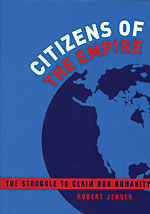
Nationalism poses a threat everywhere but should especially concern us in the United States, where the capacity for destruction in the hands of the most powerful state in the history of the world is exacerbated by a pathological hyper-patriotism that tends to suppress internal criticism and leave many unable to hear critique from outside. In other writing (Chapter 3 of Citizens of the Empire) I have outlined in some detail an argument that patriotism is intellectually and morally bankrupt. Here, let me simply point out that because a nation-state is an abstraction (lines on a map, not a naturally occurring object), assertions of patriotism (defined as love of or loyalty to a nation-state) raise a simple question: To what we are pledging our love and loyalty? How is that abstraction made real? I conclude that all the possible answers are indefensible and that instead of pledging allegiance to a nation, we should acknowledge and celebrate our connections to real people in our lives while also declaring a commitment to universal principles, but reject offering commitment to arbitrary political units that in the modern era have been the vehicle for such barbarism and brutality.

That critique applies across the board, but because of our power and peculiar history, a rejection of national fundamentalism is most crucial in the United States. The dominant conception of that history is captured in the phrase "the city upon a hill," the notion that the United States came into the world as the first democracy, a beacon to the world. In addition to setting the example, as soon as it had the capacity to project its power around the world, the United States claimed to be the vehicle for bringing democracy to that world. These are particularly odd claims for a nation that owes its very existence to one of the most successful genocides in recorded history, the near-complete extermination of indigenous peoples to secure the land and resource base for the United States. Odder still when one looks at the U.S. practice of African slavery that propelled the United States into the industrial world, and considers the enduring apartheid system -- once formal and now informal -- that arose from it. And odd-to-the-point-of-bizarre in the context of imperial America's behavior in the world since it emerged as the lone superpower and made central to its foreign policy in the post-WWII era attacks on any challenge in the Third World to U.S. dominance.

While all the empires that have committed great crimes -- the British, French, Belgians, Japanese, Russians and then the Soviets -- have justified their exploitation of others by the alleged benefits it brought to the people being exploited, there is no power so convinced of its own benevolence as the United States. The culture is delusional in its commitment to this mythology, which is why today one can find on the other side of the world peasant farmers with no formal education who understand better the nature of U.S. power than many faculty members at elite U.S. universities. This national fundamentalism rooted in the assumption of the benevolence of U.S. foreign and military policy works to trump critical inquiry. As long as a significant component of the U.S. public -- and virtually the entire elite -- accept this national fundamentalism, the world is at risk.


ECONOMICS

Economic fundamentalism, synonymous these days with market fundamentalism, presents another grave threat. After fall of the Soviet system, the naturalness of capitalism is now taken to be beyond question. The dominant assumption about corporate capitalism in the United States is not simply that it is the best among competing economic systems, but that it is the only sane and rational way to organize an economy in the contemporary world.

In capitalism, (1) property, including capital assets, is owned and controlled by private persons; (2) people sell their labor for money wages, and (3) goods and services are allocated by markets. In contemporary market fundamentalism, also referred to as neoliberalism, it's assumed that most extensive use of markets possible will unleash maximal competition, resulting in the greatest good -- and all this is inherently just, no matter what the results. The reigning ideology of so-called "free trade" seeks to impose this neoliberalism everywhere on the globe. In this fundamentalism, it is an article of faith that the "invisible hand" of the market always provides the preferred result, no matter how awful the consequences may be for real people.

A corresponding tenet of the market fundamentalist view is that the government should not interfere in any of this; the appropriate role of government, we are told, is to stay out of the economy. This is probably the most ridiculous aspect of the ideology, for the obvious reason that it is the government that establishes the rules for the system (currency, contract law, etc.) and decides whether the wealth accumulated under previous sets of rules should be allowed to remain in the hands of those who accumulated it (typically in ways immoral, illegal, or both; we should recall the quip that behind every great fortune is a great crime) or be redistributed. To argue that government should stay out of the economy merely obscures the obvious fact that without the government -- that is, without rules established through some kind of collective action -- there would be no economy. The government can't stay out because it's in from the ground floor, and assertions that government intervention into markets is inherently illegitimate are just silly.

Adding to the absurdity of all this is the hypocrisy of the market fundamentalists, who are quick to call on government to bail them out when things go sour (in recent U.S history, the savings-and-loan and auto industries are the most outrageous examples). And then there's the reality of how some government programs -- most notably the military and space departments -- act as conduits for the transfer of public money to private corporations under the guise of "national defense" and the "exploration of space." And then there's the problem of market failure -- the inability of private markets to provide some goods or provide other goods at the most desirable levels -- of which economists are well aware.

In other words, economic fundamentalism -- the worship of markets combined with steadfast denial about how the system actually operates -- leads to a world in which not only are facts irrelevant to the debate, but people learn to ignore their own experience.

On the facts: There is a widening gap between rich and poor, both worldwide and within most nations. According to U.N. statistics, about a quarter of the world's population lives on less than $1 a day and nearly half live on less than $2. The 2005 U.N. Report on the World Social Situation, aptly titled "The Inequality Predicament," stresses:

"Ignoring inequality in the pursuit of development is perilous. Focusing exclusively on economic growth and income generation as a development strategy is ineffective, as it leads to the accumulation of wealth by a few and deepens the poverty of many; such an approach does not acknowledge the intergenerational transmission of poverty."

That's where the data lead. But I want to highlight the power of this fundamentalism by reminding us of a common acronym: TGIF. Everyone in the United States knows what that means: "Thank God it's Friday." The majority of Americans don't just know what TGIF stands for, they feel it in their bones. That's a way of saying that a majority of Americans do work they generally do not like and do not believe is really worth doing. That's a way of saying that we have an economy in which most people spend at least a third of their lives doing things they don't want to do and don't believe are valuable. We are told this is a way of organizing an economy that is natural.


TECHNOLOGY

Religious, national, and economic fundamentalisms are dangerous. They are systems of thought -- or, more accurately, systems of non-thought; as Wes Jackson puts it, "fundamentalism takes over where thought leaves off" -- that are at the core of much of the organized violence in the world today. They are systems that are deployed to constrain real freedom and justify illegitimate authority. But it may turn out that those fundamentalisms are child's play compared with U.S. society's technological fundamentalism.

Most concisely defined, technological fundamentalism is the assumption that the increasing use of increasingly more sophisticated high-energy, advanced technology is always a good thing and that any problems caused by the unintended consequences of such technology eventually can be remedied by more technology. Those who question such declarations are often said to be "anti-technology," which is a meaningless insult. All human beings use technology of some kind, whether it's stone tools or computers. An anti-fundamentalist position is not that all technology is bad, but that the introduction of new technology should be evaluated on the basis of its effects -- predictable and unpredictable -- on human communities and the non-human world, with an understanding of the limits of our knowledge.

Our experience with unintended consequences is fairly clear. For example, there's the case of automobiles and the burning of petroleum in internal-combustion engines, which gave us the interstate highway system and contributes to global warming. We haven't quite figured out how to cope with these problems, and in retrospect it might have been wise to go slower in the development of a transportation system based on the car and think through the consequences.

Or how about CFCs and the ozone hole? Chlorofluorocarbons have a variety of industrial, commercial, and household applications, including in air conditioning. They were thought to be a miracle chemical when introduced in the 1930s -- non-toxic, non-flammable, and non-reactive with other chemical compounds. But in the 1980s, researchers began to understand that while CFCs are stable in the troposphere, when they move to the stratosphere and are broken down by strong ultraviolet light they release chlorine atoms that deplete the ozone layer. This unintended effect deflated the exuberance a bit. Depletion of the ozone layer means that more UV radiation reaches the Earth's surface, and overexposure to UV radiation is a cause of skin cancer, cataracts, and immune suppression.

But, the technological fundamentalists might argue, we got a handle on that one and banned CFCs, and now the ozone hole is closing. True enough, but what lessons have been learned? Society didn't react to the news about CFCs by thinking about ways to step back from a world that has become dependent on air conditioning, but instead looked for replacements to keep the air conditioning running. So, the reasonable question is: When will the unintended effects of the CFC replacements become visible? If not the ozone hole, what's next? There's no way to predict, but it seems reasonable to ask the question and sensible to assume the worst.

This technological fundamentalism makes it clear why Jackson's call for an ignorance-based worldview is so important. If we were to step back and confront honestly the technologies we have unleashed -- out of that hubris, believing our knowledge is adequate to control the consequences of our science and technology -- I doubt any of us would ever get a good night's sleep. We humans have been overdriving our intellectual headlights for some time, most dramatically in the second half of the 20th century. Most obviously, there are two places we have gone, with reckless abandon, where we had no business going -- into the atom and into the cell.

On the former: The deeper we break into the energy package, the greater the risks we take. Building fires with sticks gathered from around the camp is relatively easy to manage, but breaking into increasingly earlier material of the universe -- such as fossil fuels and, eventually, heavy metal uranium -- is quite a different project, more complex and far beyond our capacity to control. Likewise, manipulating plants through selective breeding is local and manageable, whereas breaking into the workings of the gene -- the foundational material of life -- takes us to places we have no way to understand.

We live now in the uncomfortable position of realizing we have moved too far and too fast, outstripping our capacity to manage safely the world we have created. The answer is not some naĂŻve return to a romanticized past, but a recognition of what we have created and a systematic evaluation of how to step back from our most dangerous missteps.


REDEFINING A GOOD LIFE

Central to that project is realizing that we have to learn to live with less, which we can accomplish only when we recognize that living with less is crucial not only to ecological survival but long-term human fulfillment. People in the United States live with an abundance of most everything -- except meaning. The people who have the most in material terms seem to spend the most time in therapy, searching for answers to their own alienation. This "blessed lifestyle" -- a term Bush's spokesman used in 2000 to describe the president's view of U.S. affluence -- perhaps is more accurately also seen as a curse.

Let's return to CFCs and air-conditioning. To someone who lives in Texas, with its miserable heat half the year, it's reasonable to ask: If not air-conditioning, then what? One possible reasonable response is, of course, to vacate Texas, a strategy I ponder often. More realistic: The "cracker house," a term from Florida and Georgia to describe houses built before air-conditioning that utilize shade, cross-ventilation, and various building techniques to create a livable space even in the summer in the deep South. Of course, even with all that, there are times when it's hot in a cracker house -- so hot that one doesn't want to do much of anything but drink iced tea and sit on the porch. That raises a question: What's so bad about sitting on the porch drinking iced tea instead of sitting inside in an air-conditioned house?

A world that steps back from high-energy/high-technology answers to all questions will no doubt be a harder world in some ways. But the way people cope without such "solutions" can help create and solidify human bonds. In this sense, the high-energy/high-technology world often contributes to impoverished relationships and the destruction of longstanding cultural practices and the information those practices carry. So, stepping back from this fundamentalism is not simply sacrifice but an exchange of a certain kind of comfort and easy amusement for a different set of rewards.

Articulating this is important in a world in which people have come to believe the good life is synonymous with consumption and the ability to acquire increasingly sophisticated technology. To miss the way in which turning from the high-energy/high-technology can improve our lives, then, supports the techno-fundamentalists, such as this writer in the Wired magazine:

"Green-minded activists failed to move the broader public not because they were wrong about the problems, but because the solutions they offered were unappealing to most people. They called for tightening belts and curbing appetites, turning down the thermostat and living lower on the food chain. They rejected technology, business, and prosperity in favor of returning to a simpler way of life. No wonder the movement got so little traction. Asking people in the world's wealthiest, most advanced societies to turn their backs on the very forces that drove such abundance is naĂŻve at best."

NaĂŻve, perhaps, but not as naĂŻve as the belief that unsustainable systems can be sustained indefinitely. With that writer's limited vision -- which is what passes for vision in this culture -- it's not surprising that he advocates economic and technological fundamentalist solutions:

"With climate change hard upon us, a new green movement is taking shape, one that embraces environmentalism's concerns but rejects its worn-out answers. Technology can be a font of endlessly creative solutions. Business can be a vehicle for change. Prosperity can help us build the kind of world we want. Scientific exploration, innovative design, and cultural evolution are the most powerful tools we have. Entrepreneurial zeal and market forces, guided by sustainable policies, can propel the world into a bright green future."

In other words: Let's ignore our experience and throw the dice. Let's take naiveté to new heights. Let's forget all we should have learned.


WHAT'S NEXT?

So far, it appears my criticism has been of the fundamentalist versions of religion, nation, capitalism, and high-technology. But the problem goes deeper than the most exaggerated versions of these systems. If there is to be a livable future, religion as we know it, the nation-state, capitalism, and what we think of as advanced technology will have to give way to new ways of understanding the world and organizing ourselves. We still have to find ways to struggle with the mystery of the world through ritual and art; organize ourselves politically; produce and distribute goods and services; and create the tools we need to do all these things. But the existing systems have proven inadequate to the task. On each front, we need major conceptual revolutions.

I don't pretend to have answers, nor should anyone else. We are at the beginning of a long process of redefining what it means to be human in relation to others and to the non-human world. We are still formulating questions. Some find this a depressing situation, but we could just as well see it as a time that opens incredible opportunities for creativity. To live in unsettled times -- especially times in which it's not difficult to imagine life as we know it becoming increasingly untenable -- is both frightening and exhilarating. In that sense, my friend's acknowledgement of profound grief need not scare us but instead can be a place from which we see clearly and gather the strength to move forward.

What is that path? Tracking the four fundamentalisms, we can see some turns we need to make.

Technologically: We need to stop talking about progress in terms that reflexively glorify faster and more powerful devices, and instead adopt a standard for judging progress based on the real effects on humans and the wider world of which we are a part.

Economically: We need to stop talking about growth in terms of more production and adopt a standard for economic growth and development based on meeting human needs.

Nationally: We need to stop talking about national security and the national interest -- code words for serving the goals of the powerful -- and focus on people's interests in being secure in the basics: food, shelter, education, and communal solidarity.

Religiously: We need to stop trying to pin down God. We can understand God as simply the name we give to that which is beyond our ability to understand, and recognize that the attempt to create rules for how to know God is always a failed project.

I want to end by reinforcing the ultimate importance of that recognition: Most of the world is complex beyond our ability to comprehend. It's not that there's nothing we can know through our rational faculties, but that it's essential we recognize the limits of those faculties. We need to reject the fundamentalist streak in all of us, religious or secular, whatever our political affiliation.

We need to stop mistaking cleverness for wisdom. We need to embrace our limits -- our ignorance -- in the hopes that we can stop being so stupid.

When we do that we are coming to terms with the kind of animals we are, in all our glory and all our limitations. That embrace of our limitations is an embrace of a larger world of which we are a part, more glorious than most of us ever experience.

When we do that -- if we can find our way clear to do that -- I think we make possible love in this world. Not an idealized love, but a real love that recognizes the joy that is possible and the grief that is inevitable.

It is my dream to live in that world, to live in that love.

There is much work to be done if we want that world. There is enormous struggle that can't be avoided. When we allow ourselves to face it, we will realize that ahead of us there is suffering beyond description, as well as potential for transcending that suffering.

There is grief and joy.

And there is nothing to do but face it.


Robert Jensen is a journalism professor at the University of Texas at Austin and a member of the board of the Third Coast Activist Resource Center. He is the author of The Heart of Whiteness: Race, Racism, and White Privilege and Citizens of the Empire: The Struggle to Claim Our Humanity. He can be reached at rjensen@uts.cc.utexas.edu.

Monday, May 22, 2006

5.22.06 Moyers: Pass the Bread

Pass the Bread
by Bill Moyers
Text of Baccalaureate Address
Hamilton College, Clinton, NY
May 20, 2006


I will make this brief because I know you have much to do between now and your farewell to Hamilton tomorrow, and that you are eager to get out and enjoy this perfect day in this glorious weather that somehow never gets mentioned in your promotional and recruitment literature.

One of my closest friends and colleagues, David Bate, graduated in 1938, and patriot that he is, headed right for the U.S. Navy where he served throughout World War II. David's father graduated from Hamilton in 1908 and two of his children continued the tradition. I asked David what he learned at Hamilton and he told me Hamilton is where you discover that being smart has nothing to do with being warm and dry...Just kidding! Thank you for inviting Judith and me to share this occasion with you. Fifty years ago both of us turned the same corner you are turning today and left college for the great beyond. Looking back across half a century I wish our speaker at the time had said something really useful--something that would have better prepared us for what lay ahead. I wish he had said: "Don't Go."

So I have been thinking seriously about what I might say to you in this Baccalaureate service. Frankly, I'm not sure anyone from my generation should be saying anything to your generation except, "We're sorry. We're really sorry for the mess you're inheriting. We are sorry for the war in Iraq. For the huge debts you will have to pay for without getting a new social infrastructure in return. We're sorry for the polarized country. The corporate scandals. The corrupt politics. Our imperiled democracy. We're sorry for the sprawl and our addiction to oil and for all those toxins in the environment. Sorry about all this, class of 2006. Good luck cleaning it up."

You're going to have your hands full, frankly. I don't need to tell you of the gloomy scenarios being written for your time. Three books on my desk right now question whether human beings will even survive the 21st century. Just listen to their titles: The Long Emergency: Surviving the Convergence Catastrophe; Collapse: How Societies Choose to Fail or Succeed; The Winds of Change: Weather and the Destruction of Civilizations.

These are just three of the recent books that make the apocalypse prophesied in the Bible...the Revelations of St. John...look like child's play. I won't summarize them for you except to say that they spell out Doomsday scenarios for global catastrophe. There's another recent book called The Revenge of Gaia that could well have been subtitled, "The Earth Strikes Back," because the author, James Lovelock, says human consumption, our obsession with technology, and our habit of "playing God" are stripping bare nature's assets until the Earth's only consolation will be to take us down with her. Before this century is over, he writes, "Billions of us will die and the few breeding pairs of people that survive will be kept in the Arctic where the climate remains tolerable." So there you have it: The future of the race, to be joined in a final and fatal march of the penguins.

Of course that's not the only scenario. You can Google your way to a lot of optimistic possibilities. For one, the digital revolution that will transform how we do business and live our lives, including active intelligent wireless devices that in just a short time could link every aspect of our physical world and even human brains, creating hundreds of thousands of small-scale business opportunities. There are medical breakthroughs that will conquer many ills and extend longevity. Economic changes will lift hundreds of millions of people out of absolute poverty in the next 25 years, dwarfing anything that's come along in the previous 100 years. These are possible scenarios, too. But I'm a journalist, not a prophet. I can't say which of these scenarios will prove true. You won't be bored, that's for sure. I just wish I were going to be around to see what you do with the peril and the promise.

Since I won't be around, I want to take this opportunity to say a thing or two that have nothing to do with my professional work as a journalist. What I have to say today is very personal. Here it is:

If the world confuses you a little, it confuses me a lot. When I graduated fifty years ago I thought I had the answers. But life is where you get your answers questioned, and the odds are that you can look forward to being even more perplexed fifty years from now than you are at this very moment. If your parents level with you, truly speak their hearts, I suspect they would tell you life confuses them, too, and that it rarely turns out the way you thought it would.

I find I am alternatively afraid, cantankerous, bewildered, often hostile, sometimes gracious, and battered by a hundred new sensations every day. I can be filled with a pessimism as gloomy as the depth of the middle ages, yet deep within me I'm possessed of a hope that simply won't quit. A friend on Wall Street said one day that he was optimistic about the market, and I asked him, "Then why do you look so worried?" He replied, "Because I'm not sure my optimism is justified." Neither am I. So I vacillate between the determination to act, to change things, and the desire to retreat into the snuggeries of self, family and friends.

I wonder if any of us in this great, disputatious, over-analyzed, over-televised and under-tenderized country know what the deuce we're talking about, myself included. All my illusions are up for grabs, and I find myself re-assessing many of the assumptions that served me comfortable much of my life.

Earlier this week I heard on the radio a discussion in New York City about the new Disney Broadway production of Tarzan, the jungle hero so popular when I was growing up. I remember as a kid almost dislocating my tonsils trying to recreate his unearthly sound, swinging on a great vine in a graceful arc toward the rescue of his distressed mate, Jane, hollering bloody murder all the time. So what have we learned since? That Buster Crabbe and Johnny Weismuller, who played Tarzan in the movies, never made that noise. It was a recording of three men, one a baritone, one a tenor, and one a hog caller from Arkansas--all yelling to the top of their lungs. This world is hard on believers.


As a young man I was drawn to politics. I took part in two national campaigns, served in the Kennedy and Johnson administrations, and have covered politics ever since. But I understand now what Thomas Jefferson meant back in 1789 when he wrote: "I am not a Federalist because I never submitted the whole system of my opinions to the creed of any party of men, whether in religion, in philosophy, in politics, or anything else. If I could not go to Heaven but with a party, I would not go there at all." Of course we know there'll be no parties in Heaven. No Democrats, no Republicans, no liberals, no conservatives, no libertarians or socialists. Just us Baptists.

The hardest struggle of all is to reconcile life's polar realities. I love books, Beethoven, and chocolate brownies. Yet how do I justify my pleasure in these in a world where millions are illiterate, the music never plays, and children go hungry through the night? How do I live sanely in a world so unsafe for so many?

I don't know what they taught you here at Hamilton about all this, but I trust you are not leaving here without thinking about how you will respond to the dissonance in our culture, the rivalry between beauty and bestiality in the world, and the conflicts in your own soul. All of us have to choose sides on this journey. But the question is not so much who we are going to fight against as it is which side of our own nature will we nurture: The side that can grow weary and even cynical and believe that everything is futile, or the side that for all the vulgarity, brutality, and cruelty, yearns to affirm, connect and signify. Albert Camus got it right: There is beauty in the world as well as humiliation, "And we have to strive, hard as it is, not to be unfaithful...in the presence of one or the other.

That's really what brings me here this afternoon. I did put myself in your place, and asked what I'd want a stranger from another generation to tell me if I had to sit through his speech. Well, I'd want to hear the truth: The truth is, life's a tough act, the world's a hard place, and along the way you will meet a fair share of fools, knaves and clowns--even act the fool yourself from time to time when your guard is down or you've had too much wine. I'd like to be told that I will experience separation, loss and betrayal, that I'll wonder at times where have all the flowers gone.

I would want to be told that while life includes a lot of luck, life is more than luck. It is sacrifice, study, and work; appointments kept, deadlines met, promises honored. I'd like to be told that it's okay to love your country right or wrong, but it's not right to be silent when your country is wrong. And I would like to be encouraged not to give up on the American experience. To remember that the same culture which produced the Ku Klux Klan, Tom DeLay and Abu Ghraib, also brought forth the Peace Corps, Martin Luther King and Hamilton College.

And I would like to be told that there is more to this life than I can see, earn, or learn in my time. That beyond the day-to-day spectacle are cosmic mysteries we don't understand. That in the meantime--and the meantime is where we live--we infinitesimal particles of creation carry on the miracle of loving, laughing and being here now, by giving, sharing and growing now.

Let me tell you one of my favorite stories. I read it a long time ago and it's stayed with me. There was a man named Shalom Aleicheim. He was one of the accursed of the Earth. Every misfortune imaginable befell him. He lost his wife, his children neglected him, his house burned down, his job disappeared--everything he touched turned to dust. Yet through all this Shalom kept returning good for evil everywhere he could until he died. When the angels heard he was arriving at Heaven's gate, they hurried down to greet him. Even the Lord was there, so great was this man's fame for goodness. It was the custom in Heaven that every newcomer was interrogated by the prosecuting angel, to assure that all trespasses on Earth had been atoned. But when Shalom reached those gates, the prosecuting angel arose, and for the first time in the memory of Heaven, said, "There are no charges." Then the angel for the defense arose and rehearsed all the hardships this man had endured and recounted how in all the difficult circumstances of his life he had remained true to himself and returned good for evil.

When the angel was finished, the Lord said, "Not since Job himself have we heard of a life such as this one." And then, turning to Shalom, he said, "Ask, and it shall be given to you."

The old man raised his eyes and said, "Well, if I could start every day with a hot buttered roll..." And at that the Lord and all the angels wept, at the preciousness of what he was asking for, at the beauty of simple things : a buttered roll, a clean bed, a beautiful summer day, someone to love and be loved by. These supply joy and meaning on this earthly journey.

So I brought this with me. It's an ordinary breakfast roll, perhaps one like Shalom asked for. I brought it because it drives home the last thing I want to say to you. Bread is the great re-enforcer of the reality principle. Bread is life. But if you're like me you have a thousand and more times repeated the ordinary experience of eating bread without a thought for the process that brings it to your table. The reality is physical: I need this bread to live. But the reality is also social: I need others to provide the bread. I depend for bread on hundreds of people I don't know and will never meet. If they fail me, I go hungry. If I offer them nothing of value in exchange for their loaf, I betray them. The people who grow the wheat, process and store the grain, and transport it from farm to city; who bake it, package it, and market it--these people and I are bound together in an intricate reciprocal bargain. We exchange value.

This reciprocity sustains us. If you doubt it, look around you. Hamilton College was raised here by people before your time, people you'll never know, who were nonetheless thinking of you before you were born. You have received what they built and bequeathed, and in your time you will give something back. That's the deal. On and on it goes, from generation to generation.

Civilization sustains and supports us. The core of its value is bread. But bread is its great metaphor. All my life I've prayed the Lord's Prayer, and I've never prayed, "Give me this day my daily bread." It is always, "Give us this day our daily bread." Bread and life are shared realities. They do not happen in isolation. Civilization is an unnatural act. We have to make it happen, you and I, together with all the other strangers. And because we and strangers have to agree on the difference between a horse thief and a horse trader, the distinction is ethical. Without it, a society becomes a war against all, and a market for the wolves becomes a slaughter for the lambs. My generation hasn't done the best job at honoring this ethical bargain, and our failure explains the mess we're handing over to you. You may be our last chance to get it right. So good luck, Godspeed, enjoy these last few hours together, and don't forget to pass the bread.

Saturday, May 13, 2006

5.13.06 Almond: Condoleezza Rice at Boston College? I Quit

Condoleezza Rice at Boston College? I Quit

By Steve Almond

An open letter to William P. Leahy, SJ, president of Boston College.

Dear Father Leahy,
I am writing to resign my post as an adjunct professor of English at Boston College.

I am doing so -- after five years at BC, and with tremendous regret -- as a direct result of your decision to invite Secretary of State Condoleezza Rice to be the commencement speaker at this year's graduation.

Many members of the faculty and student body already have voiced their objection to the invitation, arguing that Rice's actions as secretary of state are inconsistent with the broader humanistic values of the university and the Catholic and Jesuit traditions from which those values derive.

But I am not writing this letter simply because of an objection to the war against Iraq. My concern is more fundamental. Simply put, Rice is a liar.

She has lied to the American people knowingly, repeatedly, often extravagantly over the past five years, in an effort to justify a pathologically misguided foreign policy.

The public record of her deceits is extensive. During the ramp-up to the Iraq war, she made 29 false or misleading public statements concerning Iraq's weapons of mass destruction and links to Al Qaeda, according to a congressional investigation by the House Committee on Government Reform.

To cite one example:

In an effort to build the case for war, then-National Security Adviser Rice repeatedly asserted that Iraq was pursuing a nuclear weapon, and specifically seeking uranium in Africa.

In July of 2003, after these claims were disproved, Rice said: ''Now if there were doubts about the underlying intelligence . . . those doubts were not communicated to the president, the vice president, or to me."

Rice's own deputy, Stephen Hadley, later admitted that the CIA had sent her a memo eight months earlier warning against the use of this claim.

In the three years since the war began, Rice has continued to misrepresent or simply ignore the truth about our deadly adventure in Iraq.

Like the president whom she serves so faithfully, she refuses to recognize her errors or the tragic consequences of those errors to the young soldiers and civilians dying in Iraq. She is a diplomat whose central allegiance is not to the democratic cause of this nation, but absolute power.

This is the woman to whom you will be bestowing an honorary degree, along with the privilege of addressing the graduating class of 2006.

It is this last notion I find most reprehensible: that Boston College would entrust to Rice the role of moral exemplar.

To be clear: I am not questioning her intellectual gifts or academic accomplishments. Nor her potentially inspiring role as a powerful woman of color.

But these are not the factors by which a commencement speaker should be judged. It is the content of one's character that matters here -- the reverence for truth and knowledge that Boston College purports to champion.

Rice does not personify these values; she repudiates them. Whatever inspiring rhetoric she might present to the graduating class, her actions as a citizen and politician tell a different story.

Honestly, Father Leahy, what lessons do you expect her to impart to impressionable seniors?

That hard work in the corporate sector might gain them a spot on the board of Chevron? That they, too, might someday have an oil tanker named after them? That it is acceptable to lie to the American people for political gain?

Given the widespread objection to inviting Rice, I would like to think you will rescind the offer. But that is clearly not going to happen.

Like the administration in Washington, you appear too proud to admit to your mistake. Instead, you will mouth a bunch of platitudes, all of which boil down to: You don't want to lose face.

In this sense, you leave me no choice.

I cannot, in good conscience, exhort my students to pursue truth and knowledge, then collect a paycheck from an institution that displays such flagrant disregard for both.

I would like to apologize to my students and prospective students. I would also urge them to investigate the words and actions of Rice, and to exercise their own First Amendment rights at her speech.

Steve Almond is the author of the story collections ''The Evil B. B. Chow" and ''My Life in Heavy Metal."

Friday, May 05, 2006

5.5.06 Thomas: Where Are All the Leaders of Faith?

Thursday, May 4, 2006 by the San Francisco Chronicle
Where Are All the Leaders of Faith?
by Helen Thomas

Where are the activist priests and ministers who took strong stands during the Vietnam War and hit the streets with their protests?

Three years into the war against Iraq, the silence of the clergy is deafening, despite U.S. abuse of prisoners at Abu Ghraib and a reported American policy of shipping detainees to secret prisons abroad where, presumably, they can be tortured.

There are U.S. chaplains of many faiths serving in Iraq and Afghanistan, ministering to the men and women in uniform and reaching out to local religious leaders in both countries.

But here at home, the clergy seems to be in the same boat as the news media and most members of Congress: they are victims of the post-Sept. 11 syndrome that equates any criticism of U.S. policy with lack of patriotism.

The clergy are not alone. There is a disquieting public acceptance of the status quo. Although the Iraq war has a role in President Bush's declining standing in public opinion polls, rising gas prices may be having a bigger impact on his popularity.

During the Vietnam War, the clergy were vocal leaders of the peace movement and they picked up and marched.

I was reminded of that bygone era -- a time when everyone got involved -- with the passing last month of Rev. William Sloane Coffin, a Presbyterian minister who served as chaplain at Yale University and pastor at Riverside Church in New York.

He was a follower of civil rights leader, Rev. Martin Luther King Jr., and a liberal, to put it mildly.

Coffin went on the dangerous Freedom rides in the South in the 1960s and worked for human rights of African Americans. He became famous for his protests against the Vietnam War and later espoused the causes of gay rights and anti-nuclear proliferation. He hailed from a wealthy family, attended Ivy League schools, and served in World War II. Before attending a theological seminary, he worked for the CIA.

But he will be most remembered for his moral courage.

The Nation magazine -- which counted Coffin as a contributor -- quoted Coffin as saying he had the "sense of fulfillment from being in the right fight."

Writer and artist Robert Shetterly, Coffin's good friend, wrote on CommonDreams.org a eulogy of Coffin based on his long association with the minister, dating back to an anti-Vietnam War rally at Yale in 1968.

He recalled that Coffin had written in his latest book "Credo," a 2004 collection of his writings, that "the war against Iraq is as disastrous as it is unnecessary; perhaps in terms of its wisdom, purpose and motives, the worst war in American history. Our military men and women were not called to defend America, but rather to attack Iraq. They were not called to die for America, but rather to kill for their country. What more unpatriotic thing could we have asked of our sons and daughters?"

Shetterly's perception of Coffin was that he was not self-righteous and that he had doubts about his own convictions at times. He also wrote that Coffin made mistakes but learned from them.

Shetterly said Coffin "spent his life trying to atone for having followed military orders in 1945, putting 3,000 white Russians who fought against the Stalin communist regime, on a train from Germany to Moscow "and sure execution."

Some of Coffin's quotes are memorable.

After Sept. 11, he said the U.S. government should have vowed "to see justice done, but by force of law only, not by the law of force." He also said that "the world is too dangerous for anything but truth and too small for anything but love."

Lest I have selected Coffin's only intellectual qualities, Shetterly also describes his human side and said that he liked "a good drink. A good joke. A good song. A moral act. A worthy laugh."

Helen Thomas is a columnist for Hearst Newspapers and a member of the White House press corps.

Saturday, April 22, 2006

4.22.06 Cobb: Divine Mushroom Cloud: A Call to Worship

Divine Mushroom Cloud: A Call to Worship
by Karen Horst Cobb

On June 2nd the god of America will be paraded before the people of the earth causing them to tremble in fear. Americans will again marvel as they worship the god of their own creation. Just like the restless Israelites in the desert who grew inpatient with god and fashioned a golden calf to protect them we have grown inpatient with god and fashioned a shiny idol of power. Southern Methodist University is working with the new clergy of death who have named the idol Divine Strake.

Divine: Having the nature of or being a deity. Of, relating to, emanating from, or being the expression of a deity: sought divine guidance through meditation. Being in the service or worship of a deity; sacred. Superhuman; godlike. Supremely good or beautiful; magnificent: a divine performance of the concerto. Extremely pleasant; delightful: had a divine time at the ball. Heavenly; perfect.

The 700 tons of explosives designed to simulate the effects of a nuclear weapon will create a glorious mushroom cloud. The goal of the ammonium nitrate and fuel to be detonated on Shoshone land will cover Las Vegas with a mushroom cloud and will measure 3.5 on the Richter scale. Some believe it is in violation of the Nuclear Nonproliferation treaty which banned all testing for nuclear weapons. This simulated explosion will show the "enemy" and the war planners how the real thing will impact the ground and the air in which a nuclear bomb is detonated. Specifically, it is designed to simulate using a tactical nuclear weapon on underground facilities like the ones we are told exist in Iran. If this were the real thing the death toll would be huge, people would be incinerated in a flash with no chance to "duck and cover", much of Nevada would be contaminated with radiation. For any who might survive in the surrounding area they would experience a curse of cancers and deformities which may effect their children and their children's children. The evidence of America's idolatry is clear. We have named it Divine, worship it in our churches and trust in its power.

The names for our God used to be the Mighty God, the Everlasting Father, the Prince of Peace but the names of America's idol are Divine Hates, Divine Helcat, Divine War Hawk and we practice nuclear stockpile stewardship. Many people who identify themselves as being born again , who profess to be dead to self and alive in Christ, now put their trust in and honor the development and use of nuclear weapons. It seems that a massive shell game of mass destruction has occurred. The wizards of treachery have taken away the love of Jesus while his worshipers were distracted by politics. They have been manipulated by fear but Jesus said, " perfect love casts out fear."

Perhaps it is because many are unhappy in their daily lives due to relationship problems, economic difficulties or feelings of being disconnected. Perhaps they fear some impending doom and want to quickly alleviate their discomfort with the belief that there is a mighty force which can prevent more harm from reaching our shores. Perhaps they want to just "bring it on" so there are no scary surprises in the future. Perhaps they have an emotional need to believe they and their families are more valuable to God than those of other lands and cultures.

The Israelites who experienced the same human anxieties responded in the same way. They fashioned a golden calf which represented their need to find security against hunger, poverty and attack. They gave of their wealth to create it and celebrated their ingenuity and their ability to make a god. We read that God was angry with the people for corrupting themselves and for forgetting his promises to them. They trusted in the golden calf as they made peace offerings to it and believed it would protect them from the evil doers. After they had given their resources to the effort and confessed their faith in its ability to protect them they continued to party. Much as today's Christians supported invading the middle east after September 11 and then went shopping.

Clearly when the nuclear genie was first summoned from the bottle the nation gathered round and worshiped the power of their ingenuity. The Israelites began to follow the pillar of cloud after they repented from idolatry . We however, are following the mushroom cloud of our false god of divine hate and testing its power in the Nevada desert. Each year at tax time we contribute our wealth just like the gold smelters in the desert did when they took off their gold earrings to fashion the shiny calf. We sign our continuing pledge on our tax returns and offer our resources to our devouring nuclear god. As a nation we look for aggressive leaders who are able to bully the rest of the world. We bring out our god and parade it before our enemies and boast of its power.

Just like the Israelites in the desert we beg for a god to go before us so no harm comes our way. The actions of the fearful and proud calf worshipers of ancient times resulted in the Ten Commandments. The first and greatest is "you shall have no other Gods before me" (Exodus 34:12) and the other nine Jesus summed up as loving your neighbor as your self. Clearly many Christians in America have broken the first and greatest commandment which results in the breaking of all the rest. We can not embrace our neighbors with mushroom clouds. The nuclear god is a jealous god who will consume us all. We clearly have named our idol divine and support its worship in many of our churches.

Some leaders of America's churches remain silent on the topic of war while others proclaim its glory. Most embrace the writings and teachings of St. Augustine. When Rome was sacked by the Visigoths, the non-resistant Christians were blamed. Just war theory provided a way out of adherence to the peaceful teachings of Christ. It was a way to merge Christianity and nationalism. The church in America conveniently applied and misapplied the principles of Just war to rally the political Christians to support the war in Iraq. This embracing of violence works well for most church leaders since many of their parishioners work for companies who have military contracts, or have family members in the military as our state religion advances.

The trust in military might by many religious leaders is obvious. There are many blatant examples among political Christians. Jerry Falwell stated on CNN, "Blow them all away in the name of the lord." He and others like him are Zion's Christian Soldiers. The Council for National Policy (CNP) is the group of America's political preachers and leaders who worship the divine weapons and meet in secret. These efforts are fueled as the parishioners of mainline denominations are influenced by the para-church organization Promise Keepers. These well attended meetings are held in stadiums and attended by thousands as they support and honor the common perception of men as military aggressors. There are smaller para-church organizations which are drawing believers of all demographics into idolatry of military might. We named it Divine, we worship it and we give it power to protect us from evil.

As you have been told over and over," All options are on the table when it comes to Iran. Our president has told us he is the "decider" of who the evil doers are and who deserves to be killed. We are trusting in a man to use our man made god to destroy a perception of "evil". If the president's war planners carry out their plans many agree it would be the active beginning of WW III The nations of the world are already choosing sides and will contribute their own divine weapons to the efforts. The Shanghai Cooperation Organization(SCO) gives us an idea of how the two sides of a nuclear war will shake out.

Will we use a nuclear weapon against a threat which does not yet exist and call upon the god of this world - the god of power, dominance and military might? Robert Oppenheimer called the atomic bomb the destroyer of worlds. It has become our source of wealth, power, and the focus of our technology. We have made a deal with the devil and worship at the feet of destructive power. Many Christians won't publicly say they put their trust in our nuclear arsenal but secretly they breathe a sigh of relief that we have a national god of our very own and possess Divine weapons. Our trust in this powerful entity makes it easier to pursue the American dream and just keep shopping and owning more stuff to fill the love shaped hole in our hearts.

There are some Christians who have renounced the god of war, but more of our church leaders just remain silent. Is there any act of violence that our government could do which would cause church leaders who profess their love for the teaching of Jesus to make bold statements of love?. There is torture and they remain silent, there is imprisonment without charges and they remain silent, There are anal probes and sexual humiliation and they remain silent, there are children and women taken hostages, and they remain silent. There is the use of depleted uranium weapons which cause heinous birth defects and they remain silent, there are bomblets which children think are toys but which blow off limbs and kill them and the Christian leaders remain silent, There is the hell fire use of white phosphorous and they remain silent. There are proud boastful leaders who use Jesus' name while committing acts of extortion, thievery, and domination and falsely hold themselves up as martyrs for the false Christian god. Yet, most church leaders remain silent.

If the nuclear god is called upon to save us will they continue to remain silent? Will they continue to worship the power of the mushroom cloud in our churches? Is there any thing of Christ's words and example for which church leaders will take a stand? Is there any egregious act from which they can not look away? Those who live by the bomb will die by the bomb! This statement is not some sort of esoteric spiritual magic but is a result of natural consequences and the wisdom of the Living God. Sin is sin because the natural consequences are sure destruction. Death and destruction has been pronounced divine, churches preach it from the pulpit and look away from it's hellish fire destruction and human suffering.

Some want to ignore the issue and wash their hands of responsibly by repeating statements concerning the inevitable destruction of the "last days". Some repeat sentiments of old time hymns, "this world is not my home." Some voice the belief that we are to honor our leaders whom Christ placed in power. Or overwhelmed by the immensity of the situation, some acknowledge it's bad but just sigh, " what can you do?" There still is time to return to the peaceful message of Jesus. There is a Christ-like remnant, a church in exile and strong peace churches. Begin today to speak out.

Perhaps these are the "last days" but do you want to be on the side of love and compassion or on the side of death suffering and destruction? Will you be found worshiping the power of the living God or the power of the idol of death? Like it or not, for now this world is our home. Maybe you do not value your earthly existence but your earthy family members will suffer and die without you speaking a word of protest. In fact you will have contributed to the mass destruction. In a representative government the citizens are the leaders and responsible for influencing the laws. Sometimes it works and sometimes it doesn't but it is our responsibility to try. Yes it is bad but you can and you must do everything in your power to speak out to prevent the use of nuclear weapons.

The test on June 2nd, the trial run of the use of a nuclear weapon is still six weeks away. Perhaps we can make a difference and change the course of history. Everyone has three people representing them in Washington where the powers are unleashed. We each have two US senators and one US representative. If you don't know how to contact yours find out. Start by speaking out and shaping the actions of our representative government. Then, work in any way you can to make every church a peace church and live love and compassion. Chose ye this day whom you will serve.

Karen Horst Cobb wrote No Longer a Christian and No Longer a Christian - Part II published by CommonDreams.org in the fall of 2004 and several other articles on false christianity. She is a mother and a grandmother, and with God's grace, tries to follow the example of Christ as she speaks Christ's message to the world that there is no Government Issue Jesus (GI-Joe Jesus.) cairnhcobb@msn.com