Tuesday, April 10, 2007

Ifill: Trash Talk Radio

Published on Tuesday, April 10, 2007
Trash Talk Radio
by Gwen Ifill

Let’s say a word about the girls. The young women with the musical names. Kia and Epiphanny and Matee and Essence. Katie and Dee Dee and Rashidat and Myia and Brittany and Heather.

The Scarlet Knights of Rutgers University had an improbable season, dropping four of their first seven games, yet ending up in the N.C.A.A. women’s basketball championship game. None of them were seniors. Five were freshmen.

In the end, they were stopped only by Tennessee’s Lady Vols, who clinched their seventh national championship by ending Rutgers’ Cinderella run last week, 59-46. That’s the kind of story we love, right? A bunch of teenagers from Newark, Cincinnati, Brooklyn and, yes, Ogden, Utah, defying expectations. It’s what explodes so many March Madness office pools.

But not, apparently, for the girls. For all their grit, hard work and courage, the Rutgers girls got branded “nappy-headed ho’s” — a shockingly concise sexual and racial insult, tossed out in a volley of male camaraderie by a group of amused, middle-aged white men. The “joke” — as delivered and later recanted — by the radio and television personality Don Imus failed one big test: it was not funny.

The serial apologies of Mr. Imus, who was suspended yesterday by both NBC News and CBS Radio for his remarks, have failed another test. The sincerity seems forced and suspect because he’s done some version of this several times before.

I know, because he apparently did it to me.

I was covering the White House for this newspaper in 1993, when Mr. Imus’s producer began calling to invite me on his radio program. I didn’t return his calls. I had my hands plenty full covering Bill Clinton.

Soon enough, the phone calls stopped. Then quizzical colleagues began asking me why Don Imus seemed to have a problem with me. I had no idea what they were talking about because I never listened to the program.

It was not until five years later, when Mr. Imus and I were both working under the NBC News umbrella — his show was being simulcast on MSNBC; I was a Capitol Hill correspondent for the network — that I discovered why people were asking those questions. It took Lars-Erik Nelson, a columnist for The New York Daily News, to finally explain what no one else had wanted to repeat.

“Isn’t The Times wonderful,” Mr. Nelson quoted Mr. Imus as saying on the radio. “It lets the cleaning lady cover the White House.”

I was taken aback but not outraged. I’d certainly been called worse and indeed jumped at the chance to use the old insult to explain to my NBC bosses why I did not want to appear on the Imus show.

I haven’t talked about this much. I’m a big girl. I have a platform. I have a voice. I’ve been working in journalism long enough that there is little danger that a radio D.J.’s juvenile slap will define or scar me. Yesterday, he began telling people he never actually called me a cleaning lady. Whatever. This is not about me.

It is about the Rutgers Scarlet Knights. That game had to be the biggest moment of their lives, and the outcome the biggest disappointment. They are not old enough, or established enough, to have built up the sort of carapace many women I know — black women in particular — develop to guard themselves against casual insult.

Why do my journalistic colleagues appear on Mr. Imus’s program? That’s for them to defend, and others to argue about. I certainly don’t know any black journalists who will. To his credit, Mr. Imus told the Rev. Al Sharpton yesterday he realizes that, this time, he went way too far.

Yes, he did. Every time a young black girl shyly approaches me for an autograph or writes or calls or stops me on the street to ask how she can become a journalist, I feel an enormous responsibility. It’s more than simply being a role model. I know I have to be a voice for them as well.

So here’s what this voice has to say for people who cannot grasp the notion of picking on people their own size: This country will only flourish once we consistently learn to applaud and encourage the young people who have to work harder just to achieve balance on the unequal playing field.

Let’s see if we can manage to build them up and reward them, rather than opting for the cheapest, easiest, most despicable shots.

Gwen Ifill is a senior correspondent for “The NewsHour With Jim Lehrer” and the moderator of “Washington Week.”

Monday, March 26, 2007

Carroll: Americans Face a Moral Reckoning


Americans Face A Moral Reckoning
by James Carroll

You have been reading The Sorrow of War by Bao Ninh, the classic account of what in Vietnam is called the American war. The title of Bao Ninh’s novel captures the feeling of grief and loss that always comes in the wake of violent conflict. Allowing room for fear, grief, and loss must define the dominant experience in Iraq today, where the suffering caused by this American war mounts inexorably.

But sorrow has also emerged as a note of life in the Unites States lately. Many comparisons are drawn between this nation’s misadventures in Iraq and Vietnam, but what you are most aware of is the return of a clenched feeling in your chest, a knot of distressed sadness that is tied to your country’s reiteration of the tragic error. After the chaotic end of the Vietnam War in 1975, you were like many Americans in thinking with relief that the nation would never know — or cause — such sorrow again.

The sorrow is back. Everywhere you go, friends greet one another with a choked acknowledgment of a nearly unspeakable frustration at what unfolds in Iraq. This seems true whether people oppose the war absolutely, or only on pragmatic terms; whether they want US troops out at once, or over time. Even about those distinctions, little remains to be said. Bush’s contemptuous carelessness, his inner circle’s corrupt enabling, the Pentagon’s dependable launching of folly after folly, the Democrats’ ineffectual kibitzing, even your heartfelt concern for the troops — these subjects have exhausted themselves. The “surge” of the January escalation was preceded by the surge of public anguish that resulted in Republican losses in November. That election was a stirring rejection of the administration’s purposes in Iraq, a rejection promptly seconded by the Iraq Study Group. But so what? Bush’s purposes hold steady, and their poison tide now laps at Iran.

Why should you not be demoralized and depressed? But the sorrow of war goes deeper than the mistaken policies of a stubborn president. Next to Bao Ninh’s book on your shelf stands The Sorrows of Empire by Chalmers Johnson. That title suggests how far into the bone of your nation the pins of this problem are sunk. In effect, the disastrous American war in Iraq is the text, while America’s militarized way of being in the world is the context. Armed power at the service of US economic sway has made a putative enemy of a vast population around the globe, and that enemy’s vanguard are the terrorists. Violent opposition to the American agenda increases with each surge from Washington, whatever its character. Both text and context reveal that every dream of empire brings sorrow, obviously so to the victims of imperial violence, but also to the imperial dreamers, whether or not they consciously associate with what is being done in their name.

But the word sorrow implies more than grief and loss. The palpable sadness of a people reluctantly at war can push toward a fuller moral reckoning with the condition of a nation that has made its own economic supremacy an absolute value. To take on the question of an economy advanced with little regard for its sustainability, much less for its justice, implies a move away from the focus on Bush’s venality to a broader responsibility. How do the sorrows of war and empire implicate you?

The simplest truth is that the economic system that so benefits you is steadily eroding democracy by transferring the power to shape the future, both within states and among them, to ever smaller elites. At the same time, wealth multiplies and concentrates itself, while impoverishing more and more human beings. Everything from US oil consumption, to global trade structures, to the iron law of cheap labor, to immigration policies, to the psychology of the gated community, to the gated idea of national sovereignty, to the distractions of celebrity culture — all of this supports what is called the American way of life. Yours. If finally seen to be the source of multiple sorrows at home and abroad, can this way of life prompt a deeper confrontation with its true costs and consequences? You need not reduce social ills to personal morality — or let Bush off the hook for his wholly owned war — to acknowledge the complicity attached to mere citizenship in a war-making, imperial nation. In that case, can you measure your sorrow against the word’s other meaning, which is contrition?

James Carroll’s column appears regularly in the Boston Globe.

James Carroll was born in Chicago in 1943, and raised in Washington where his father, an Air Force general, served as the Director of the Defense Intelligence Agency. Carroll attended Georgetown University before entering the seminary to train for the Catholic priesthood. He received BA and MA degrees from St. Paul’s College, the Paulist Fathers’ seminary in Washington, and was ordained to the Catholic priesthood in 1969. Carroll served as Catholic Chaplain at Boston University from 1969 to 1974 and then left the priesthood to become a writer.

In 1974 Carroll was Playwright-in-Residence at the Berkshire Theater Festival in Stockbridge, MA. In 1976 he published his first novel, Madonna Red, which was translated into seven languages. Since then he has published nine additional novels, including the New York Times bestsellers Mortal Friends (1978), Family Trade (1982), and Prince of Peace (1984). His novels The City Below (1994) and Secret Father (2003) were named Notable Books of the Year by the New York Times. Carroll’s essays and articles have appeared in The New Yorker, Daedalus, and other publications. His op-ed page column has run weekly in the Boston Globe since 1992.

Carroll’s memoir, An American Requiem: God, My Father, and the War that Came Between Us, received the 1996 National Book Award in nonfiction and other awards. His book Constantine’s Sword: The Church and the Jews: A History, published in 2001, was a New York Times bestseller and was honored as one of the Best Books of 2001 by the Los Angeles Times, the Christian Science Monitor, and others. It was named a Notable Book of the Year by the New York Times, and won the Melcher Book Award, the James Parks Morton Interfaith Award, and National Jewish Book Award in History. Responding to the Catholic sex abuse crisis in 2002, Carroll published Toward A New Catholic Church: The Promise of Reform. In 2004 he published Crusade: Chronicles of an Unjust War, adapted from his Boston Globe columns since 9/11. In May 2005, he published House of War: The Pentagon and the Disastrous Rise of American Power, a history of the Pentagon, which the Chicago Tribune called “the first great non-fiction book of the new millennium.”

Carroll is a regular participant in on-going Jewish-Christian-Muslim encounters at the Shalom Hartman Institute in Jerusalem. Carroll is a member of the Council of PEN-New England, which he chaired for four years. He has been a Shorenstein Fellow at the Kennedy School of Government at Harvard University and a Fellow at the Center for the Study of Values in Public Life at the Harvard Divinity School. He is a trustee of the Boston Public Library, a member of the Advisory Board of the International Center for Ethics, Justice, and Public Life at Brandeis University, and a member of the Dean’s Council at the Harvard Divinity School. Carroll is a Fellow of the American Academy of Arts and Sciences, and a Distinguished Scholar-in-Residence at Suffolk University.

James Carroll lives in Boston with his wife, the novelist Alexandra Marshall. They have two grown children.

Sunday, March 11, 2007

Ramesh: An Activist Returns to the Novel

An Activist Returns To The Novel
by Randeep Ramesh

Many had written off the chances that Arundhati Roy would return to the world of fiction. Her astounding first novel, The God of Small Things, won the Booker in 1997. Ten years and 6 million copies later there was still no repeat of the lyrical, whirling debut. Instead Roy turned to lobbing literary Molotov cocktails at Enron, George Bush's war on terror and the World Trade Organisation in the form of incendiary polemics. No one could accuse her of having writers' block: she churned out six books, collections of her essays with titles such as Power Politics and An Ordinary Person's Guide to Empire.

Dispensing with story-writing, she pursued a career in social activism, appearing at anti-war rallies and using her celebrity to raise the profiles of unfashionable causes - Kashmiris on death row, the rights of tribal communities in India, hardscrabble suicides in the country's farming belt.

But recently the 45-year-old quietly announced that she would be stepping back from the public stage to write her second novel. The last person to know, apparently, was her agent, David Godwin, who had negotiated for her a million-dollar advance for The God of Small Things. "David rang me saying, 'Why did you not tell me? I have had hundreds of calls from publishers.' I thought it was so funny, I mean let's have a bidding war for a non-existent book," Roy says.

Sitting in her Delhi rooftop flat, whose dark tiled and light wood-lined interior the former architecture student designed, Roy says she has already begun writing the new novel but has no idea when it will be finished. The whisper was that it would be about Kashmir, the revolt-scarred Himalayan state, but Roy shakes her head sending ripples through her grey-flecked curls. "It is not true. My fiction is never about an issue. I don't set myself some political task and weave a story around it. I might as well write a straightforward nonfiction piece if that is what I wanted to do."

A clue about where Roy is heading may be gleaned from her current reading. On her coffee table rests a book by Bono, while at her bedside are works by the radical American founding father Thomas Paine and Victorian novelist Charles Dickens. What these two writers share is their defence of the French Revolution, and an empathy with the lower classes who pulled down the ruling elite. "In so many ways Paris then could be Delhi now. It is a conceit to think that all that we say is new and original."

Roy says India today, like pre-revolutionary France, is poised "on the edge of violence". As she sees it, the country of her birth is not coming together but coming apart - convulsed by "corporate globalisation" at an unprecedented, unacceptable velocity. "The inequalities become untenable."

Roy says she is not taking refuge from her politics in the world of literature. She answers her own door and makes guests tea herself, remarkable in a country where even middle-class households have servants. She is still married to filmmaker Pradip Krishen but the flat is "her space". He lives in another house.

"Living with my own contradictions is hard enough - forcing my political views on someone else, on their lifestyle and the choices they make is not something I want to do. It distorts a relationship beyond redemption. So, I decided to have my own place."

Roy's dire predictions about India have left her isolated when mainstream opinion seems convinced that the country, with its nuclear bombs and slick Bollywood movies, is the next superpower-in-waiting. Roy says some parts of the country, such as the western state of Gujarat - the scene of a bloody pogrom against Muslims five years ago - are off limits to her because of her campaigning.

A few years ago she was briefly imprisoned for contempt of court while protesting against the country's controversial Narmada Dam project. The God of Small Things produced obscenity charges and a court case that ran for a decade, only to be dismissed last month.

She first shot to prominence in 1994 with a scathing film review entitled The Great Indian Rape Trick, about the movie Bandit Queen, in which she questioned the right to "restage the rape of a living woman without her permission".

Roy has been consistent in her view that writers have a responsibility to their subjects. She says she could not read the blockbuster Maximum City, a portrait of Mumbai by expatriate Indian writer Suketu Mehta, because the book contains a passage in which the writer is a bystander while people in custody are beaten and tortured by the city's police.

"When you witness torture you are seeing someone humiliated. In front of you. It is not a neutral act. Certainly you have the permission of the torturer, but you do not have the permission of the tortured [to record it]."

Unlike other Indian-born writers who have relocated to the US and Europe, Roy is determined to remain a thorn in the side of the establishment in India. "Here you see what's happening. People are driven out of villages, driven out of the cities, there's a kind of insanity in the air and all of it held down by our mesmeric, pelvic-thrusting Bollywood movies. The Indian middle class has just embarked on this orgy of consumerism."

But she admits that the kinds of non-violent protests she has taken part in for a decade have failed in India, a republic founded on the Gandhi-ite principles of peaceful resistance. "I am not such an uninhibited fan of Gandhi. After all, Gandhi was a superstar. When he went on a hunger strike he was a superstar on a hunger strike. But I don't believe in superstar politics. If people in a slum are on a hunger strike, no one gives a shit."

Roy says activists have been "exhausted" by their attempts to influence the courts and the press and now says she does not "condemn people taking up arms" in the face of state repression.

"It would be immoral for me to preach violence unless I were prepared to resort to it myself. But equally, it is immoral for me to advocate feelgood marches and hunger strikes when I'm not bearing the brunt of unspeakable violence. I certainly do not volunteer to tell Iraqis or Kashmiris or Palestinians that if they went on a mass hunger strike they would get rid of the military occupation. Civil disobedience doesn't seem to be paying dividends."

Instead of the Indian state caving in to the moral righteousness of the numerous causes Roy supports, she says it merely moved to co-opt its adversaries. The power of argument, even in the world's biggest democracy, has been shrunk by the argument of power.

Roy says she was aghast to learn that a fellow Indian environmental campaigner accepted a million-dollar award from the transnational metals firm Alcan, which has been accused of grabbing tribal land in eastern India. The tentacles of big business have learned to embrace non-government organisations. The result, she claims, is that the charitable trusts of Tata, India's largest private company, fund "half the activists in the country".

She feels frustrated by the state's ability to brush aside non-violent resistance movements. "This has sapped the energy from people's movements. The very Gandhian Narmada movement [the grassroots group which campaigned against big dams in India] knocked on the door of every democratic institution for years and has been humiliated. It has not managed to stop a single dam from going ahead. In fact the dam industry has a new spring in its step."

Roy says she had given ideological opponents a handy hate figure. "In India I'm portrayed more as a hysterical, lying, anti-national harridan.

"In this adversarial game that goes on, you can get pinned down to spewing facts and numbers, but those are not the only truths ... I've done that. I've fought that battle," she says. "But the distillation of those things into literature is a different kind of intervention."

Saturday, February 03, 2007

Molly Ivins, 1944-2007


Wednesday, January 31, 2007
The Texas Observer
Sharp Reporting from the Strangest State in the Union

Statement from The Texas Observer (obituary follows)

To Our Readers and Friends

Molly Ivins left her editor's chair at The Texas Observer more than 30 years ago and went on to play a larger stage. But she never left us behind. She remained convinced that Texas needed a progressive, independent voice to call the powerful to account and to stand up for the common folk. She kept our voice alive. More than once, when the paper was on the brink of insolvency, she delivered speeches and gave us the honorariums. She donated royalties from her best-selling book Shrub to keep the doors open. Her determination and efforts sustained the Observer as a magazine, as a family, and as a community.

Molly was a hero. She was a mentor. She was a liberal. She was a patriot. She was a friend. And she always will be. With Molly's death we have lost someone we hold dear. What she has left behind we will hold dearer still.

Despite her failing health, and an impending ice storm, Molly insisted on being driven to the Observer’s most recent public event in early January so she could thank our supporters.

Observer writers are useful, she explained to the crowd, in much the same way as good hunting dogs. Turn them loose, let them hunt. When they return with their prey, pat them on the head, say a few words of praise, and set them loose to hunt again.

For the time being, The Texas Observer's web site will be dedicated to remembering Molly, her work, her wit, her contributions to the political discourse of a nation. We invite readers to submit their own thoughts and recollections, to say a few words of praise.

Then, we will return to the hunt.

Obituary for Molly Ivins

Syndicated political columnist Molly Ivins died of breast cancer Wednesday evening at her home in Austin. She was 62 years old, and had much, much more to give this world. She remained cheerful despite Texas politics. She emphasized the more hilarious aspects of both state and national government, and consequently never had to write fiction. She said, “Good thing we’ve still got politics—finest form of free entertainment ever invented.”

Molly had a large family, many namesakes, hundreds of close friends, thousands of colleagues and hundreds of thousands of readers.

She and her two siblings, Sara (Ivins) Maley of Albuquerque, New Mexico, and Andy Ivins of London, Texas, grew up in Houston. Her father, James Ivins, was a corporate lawyer and a Republican, which meant she always had someone to disagree with over the dinner table. Her mother, Margot, was a homemaker with a B.A. in psychology from Smith College.

In addition to her brother and sister, Molly is survived by sister-in-law Carla Ivins, nephew Drew and niece Darby; niece Margot Hutchison and her husband, Neil, and their children Sam, Andy and Charlie of San Diego, Calif. and nephew Paul Maley and his wife, Karianna, and their children Marty, Anneli and Finnbar of Eltham, Victoria, Australia.

Molly followed her mother to Smith and received a B.A. in 1966, followed by an M.A. from the Columbia University Graduate School of Journalism and an honorary doctorate from Haverford College.

Her full list of books and awards will be abbreviated here. In addition to compilations of her brilliant, hilarious liberal columns, she wrote with Lou Dubose Shrub: The Short But Happy Political Life of George W. Bush (Random House 2000) and Bushwhacked: Life in George W. Bush’s America (Random House 2003). She was working on a Random House book documenting the Bush administration’s assault on the Bill of Rights when she died.

Molly, being practical, used many of her most prestigious awards as trivets while serving exquisite French dishes at her dinner parties. Her awards include the William Allen White Award from the University of Kansas, the Eugene V. Debs award in the field of journalism, many awards for advocacy of the First Amendment of the U.S. Constitution and the David Nyhan Prize from the Shorenstein Center at the Kennedy School at Harvard.

Although short, Molly’s life was writ large. She was as eloquent a speaker and teacher as she was a writer, and her quips will last at least as long as Will Rogers’. She dubbed George W. Bush “Shrub” and Texas Governor Rick Perry “Good Hair.”

Molly always said in her official résumé that the two honors she valued the most were (1) when the Minneapolis Police Department named their mascot pig after her (She was covering the police beat at the time.) and (2) when she was banned from speaking on the Texas A&M University campus at least once during her years as co-editor of The Texas Observer (1970-76). However, she said with great sincerity that she would be proudest of all to die sober, and she did.

She worked as a reporter for The New York Times (1976-82) in New York and Albany and later as Rocky Mountain Bureau Chief covering nine mountain states by herself. After working for the staid Times where she was heavily edited, Molly cut loose and became a columnist for the Dallas Times Herald. When the Herald folded, she signed on as a columnist for the Fort Worth Star-Telegram. In 2001, she became syndicated, eventually appearing in 400 newspapers.

She never lost her love for The Texas Observer or her conviction that a free society relies on public-interest journalism. She found that brand of journalism the most fun.

In recent years she shamelessly used her national and international contacts to raise funds for the Observer, which has always survived on a shoestring. More than $400,000 was contributed to the feisty little journal at a roast honoring Molly in Austin October 8.

Molly’s enduring message is, “Raise more hell.”

To read more about Molly Ivins or to make a comment about her, go to www.texasobserver.org. Tax-deductible contributions in her honor may be made to The Texas Observer, 307 West Seventh Street, Austin, TX 78701 or the American Civil Liberties Union, 127 Broad Street, 18th floor, New York, NY 10004, www.aclu.org.

A memorial service for Molly will be held on Sunday, Feb. 4, 2:00 p.m. at the First United Methodist Church, 1201 Lavaca, Austin, TX.

Monday, January 15, 2007

Gonsalves: Be Your Own King


Be Your Own King
By Sean Gonsalves, AlterNet. Posted January 15, 2007.

"We cannot remain silent as our nation engages in one of history's most cruel and senseless wars. During these days of human travail we must encourage creative dissenters. We need them because the thunder of their fearless voices will be the only sound stronger than the blasts of bombs and the clamor of war hysteria." - Rev. Martin Luther King Jr.

Martin Luther King Jr. Day: A paid federal feel-good holiday in which America congratulates itself on how "far" we've come since the good ol' days of unchallenged white supremacy, traditionally celebrated with "Keep the Dream Alive" exhortations and Negro spirituals.

Though King's dream speech is recognized as a watershed moment in the history of U.S. race relations, the post-King era, in which my generation (and today's youngins) came of age, has made its own unwitting contributions: hip hop and 9/11 political rage, which is inextricably linked to the xenophobia swirling around the "illegal immigrant debate."

Hip hop has integrated the cultural landscape that today's youth roam. And 9/11 made Arabs and Muslims America's new niggers -- the target of blanket stereotypes, hypocritical moral scrutiny, and even open attack.

Behind all the Kumbaya-ism is the relevant King -- the prophetic preacher who talked about, not just race, but war and poverty.

Yes, it's true that King apparently pulled a Jayson Blair on a college paper. He wasn't always faithful to his wife and because of his rough, stubbly facial hair, he used shaving lotion that stank so bad, he had to douse himself in Aramis aftershave to make himself smell like a King again.

And have you seen that famous picture of King, taken just moments after he was shot in the neck on the balcony of the Lorraine Motel? Two of his aides are kneeling next to his limp body, pointing in the direction of where they thought the shot had been fired.

If that picture had been taken just a few seconds earlier, it would have captured King with a cigarette in his hand. One of King's aides removed the cigarette before it could be photographed.

While haters point to these things as proof that King is unworthy of adulation, it had the opposite effect on me, similar to my reaction when I discovered Thomas Jefferson owned and fathered slaves. I was inspired because King (and Jefferson) were no longer mythical gods but flawed human beings who achieved greatness. That means ordinary people like me could do extraordinary things, despite fundamental flaws.

One King question I do share with Reagan-Bush admirers, though -- why did Ronald Reagan sign the bill that made King's birthday a federal holiday?

The great African-American preacher Charles "the Harvard Whooper" Adams raised the question during a 1998 sermon at the celebrated Riverside Church.

As Michael Eric Dyson quotes Adams in his very relevant King biography, "I May Not Get There With You: The True Martin Luther King, Jr.," the holiday bill was passed by essentially the same Congress, "and signed by the same President, that had refused to pass a new civil rights bill in the 1980s."

These lawmakers are the same folks, Adams went on to say, that "refused to demand the immediate release of Nelson Mandela; ... devastated the Civil Rights Commission; amputated the legs and arms of the Equal Employment Opportunity Commission; cut off necessary support systems for the poor ... polluted the air, destroyed jobs; (and) carried on an illegal war in Nicaragua."

"Now why did Ronald Reagan sign that bill? Could it be that Mr. Reagan understood that the ease-ee-est way to get rid of Martin Luther King Jr. is to worship him? To honor him with a holiday that he never would have wanted -- to celebrate his birth and his death, without committing ourselves to his vision and his love. It is easier to praise a dead hero than to recognize and follow a living prophet."

And here's the kicker: "the best way to dismiss any challenge is to exalt and adore the empirical source through which the challenge has come."

Amen, Rev'run Adams. Forget King worship. Be your own King and let them hear the thunder of your fearless voice.

Sean Gonsalves is a Cape Cod Times staff reporter and a syndicated columnist.

Tuesday, December 19, 2006

Jackson: Peace is at the heart of the Christmas Story

Published on Tuesday, December 19, 2006 by the Chicago Sun-Times
Peace Is At the Heart of the Christmas Story
by Jesse Jackson

Christmas -- the mass celebrating the birth of Christ -- is the biggest shopping season of the year. To save Christmas, some on the right seem to think the best thing is to commercialize it. They insist stores advertise "Christmas sales," not holiday sales. They judge leaders by whether they send out cards wishing a "Merry Christmas," and not simply a happy holiday.

But shopping isn't the point of the story. It's not about exchanging Christmas cards, or about holiday parties. The story of Christmas is about a couple -- Mary and Joseph -- forced by an oppressive imperial government to leave their home to travel far to be counted in the census. When they got there, they were like immigrants, homeless in a strange land. The innkeeper had no room for the strange couple. If he had understood who the baby was, he would have offered them his bed.

Christmas is the story of a child born in a cow's barn, and placed in a manger, a makeshift crib. Mary and Joseph had no address, so it wasn't about exchanging cards. It wasn't about purchasing gifts. Yes, wise men left their daily ways, followed the star, and brought gifts to the child, while others might have stayed away from a poor child with little hope. The wise men were wise not because of the value of their gifts, but in their ability to see what the innkeeper missed: the potential of the infant asleep in a wooden manger. The Christmas story instructs us to treasure every child -- even what are now delicately called "at risk children" -- for we do not know what gifts even the poorest child of a homeless couple may possess.

What is Christmas about? It is about an oppressed people praying for a Messiah, a mighty warrior who would conquer their oppressors. He would come, they thought, assemble a great army and conquer the Roman legions. The expectation grew so high that even Herod grew uneasy. But when the Messiah came, he came as the prince of peace, not the marshal of war. He taught love and hope and charity, not violence and vengeance. He was the greatest liberator of them all, but he carried no arms, and provisioned no army. His army would transform the world, but it consisted of the legions of the faithful struggling to follow in his path.

Clearly, too few get the point of the story. Sales are reportedly up this year, particularly in the high-end, exclusive stores. But the moral report is grim. In this rich country, poverty is up, homelessness is up, hunger is up. Inequality is at obscene levels. The United States witnesses record numbers of billionaires and growing numbers of families without shelter, working people without health insurance, poor children without adequate nutrition. After Katrina, the saints didn't come marching into New Orleans. And even now, the survivors are still scattered across the 50 states, their homes still not rebuilt, their government still failing them. Poverty has been erased not from our streets but from our public debate, as politicians cater to their wealthy donors or their largely middle-income voters.

Peace reports are also dire. Our soldiers are mired in armed occupations of Iraq and Afghanistan. Our cities are girded against terrorist attack. We spend more than $500 billion a year on the mightiest military that the world has ever known, but we are more insecure than ever. We turn our backs on the genocide taking place in Darfur. We stain our own reputation -- and our own Constitution -- with torture, renditions and detentions without review. The image of the hooded prisoner of Abu Ghraib -- arms outstretched, bag over his head, electric shock device attached to his body -- indicts us all as we remember the suffering of the cross.

You don't have to be Christian to understand the point of the Christmas story. So let each of us pledge to celebrate the real deal this year. It's far more important that the Christmas story be in our souls than our stores. Let us gather and embrace our families. Let us join together to protect the babies in the dawn of life, care for the elderly in the dusk of life. Let us nurture the sick, shelter the homeless. Stop for the stranger on the Jericho Road. Work for the promise of peace. Surely that is the point of the story.

Monday, December 11, 2006

Some Presidents Speak of Prayer, Mutual Respect and Love, Mean it, and are Taken Seriously

As our 39th president, James Earl Carter, Jr., who brokered the Camp David Accords, the Middle East's longest lasting and most important peace treaty, speaks out eloquently again in behalf of peace and justice in his new book, Palestine: Peace Not Apartheid, and nobly weathers the slanders of those who have no use for peace or justice, it's high time Americans took another look and listened carefully once again to the parting words our 34th president, Dwight David Eisenhower. Wise statesmen work for the welfare of humanity even while they strive to promote the interests of their national or racial groups.

Click here to access video of the 34th President's Farewell Address to the Nation: Burn these Republican Words into Your Mind

Posted by Evan Derkacz on December 11, 2006 at 1:35 PM.

On January 17, 1961, Dwight D. Eisenhower said goodbye to public office with an address that concluded with the words below [strangely, the Eisenhower Library's version and the audio in the video to the right, differ slightly. Brackets represent the text in the Library version omitted from the audio file...].

You're familiar with the warnings in this speech against the "military-industrial complex," but the subtler parts of the speech are every bit as powerful and refreshing...

"As we peer into society's future, we - you and I, and our government - must avoid the impulse to live only for today, plundering for our own ease and convenience, the precious resources of tomorrow. We cannot mortgage the material assets of our grandchildren without asking the loss also of their political and spiritual heritage. We want democracy to survive for all generations to come, not to become the insolvent phantom of tomorrow.

"During the long lane of the history yet to be written America knows that this world of ours, ever growing smaller, must avoid becoming a community of dreadful fear and hate, and be, instead, a proud confederation of mutual trust and respect.

"[Such a confederation must be one of equals. The weakest must come to the conference table with the same confidence as do we, protected as we are by our moral, economic, and military strength. That table, though scarred by many past frustrations, cannot be abandoned for the certain agony of the battlefield.]

"[Disarmament, with mutual honor and confidence, is a continuing imperative.] Together we must learn how to compose differences, not with arms, but with intellect and decent purpose. Because this need is so sharp and apparent I confess that I lay down my official responsibilities in this field with a definite sense of disappointment. As one who has witnessed the horror and the lingering sadness of war - as one who knows that another war could utterly destroy this civilization which has been so slowly and painfully built over thousands of years - I wish I could say tonight that a lasting peace is in sight.

"Happily, I can say that war has been avoided. Steady progress toward our ultimate goal has been made. But, so much remains to be done. As a private citizen, I shall never cease to do what little I can to help the world advance along that road.

"So - in this my last good night to you as your President - I thank you for the many opportunities you have given me for public service in war and peace. I trust that in that service you find some things worthy; as for the rest of it, I know you will find ways to improve performance in the future.

"You and I, my fellow citizens, need to be strong in our faith, that all nations, under God, will reach the goal of peace, with justice. May we be ever unswerving in devotion to principle, confident but humble with power, diligent in pursuit of the Nation's great goals.

"To all the peoples of the world, I once more give expression to America's prayerful and continuing aspiration:

"We pray that peoples of all faiths, all races, all nations, may have their great human needs satisfied; that those now denied opportunity shall come to enjoy it to the full; that all who yearn for freedom may experience its spiritual blessings; that those who have freedom will understand, also, its heavy responsibilities; that all who are insensitive to the needs of others will learn charity; that the scourges of poverty, disease and ignorance will be made to disappear from the earth, and that, in the goodness of time, all peoples will come to live together in a peace guaranteed by the binding force of mutual respect and love."

Friday, December 01, 2006

Arnold: The Way to Egress


Published on Friday, December 1, 2006 by CommonDreams.org
The Way to the Egress
by Caroline Arnold

Phineas Taylor Barnum, the great 19th century American showman who was called the "Prince of Humbug," kept people moving through his exhibitions with signs pointing "This way to the Egress."

It is unclear how many customers were actually tricked into exiting by seeking an egress, but people everywhere are tickled by that story, which slyly suggests that others are ignorant and gullible.

Similarly, we like to quote P.T. Barnum as saying "There’s a sucker born every minute." But he didn’t say that, which is another story to tickle our funnybones, and possibly offer an instructive story for this Christmas season, when we desperately need an egress from a cruel, unjust war, and from a chamber of horrors including torture, civil war and nuclear weapons.

In 1868, in the wake of evangelists preaching that there had once been giants roaming the earth, George Hull had an anatomically correct giant carved from a slab of gypsum 12' x 4' x 2' , buried it beside a barn near Cardiff NY, and "discovered" it a year later. Hull immediately started charging a quarter to see the wonder, then quickly doubled the price.

Clergymen decreed it was a fossilized giant from Biblical times; scientists decided it was an authentic ancient statue.; no-one suggested it was a hoax. Hull soon sold a majority interest in his ‘Cardiff Giant’ for $30,000 to a syndicate headed by David Hannum, who moved it to Syracuse and charged $1 to view it.

Naturally, P.T. Barnum wanted piece of this action, and tried to buy the giant for $50,000. When he was rebuffed he quietly hired a crew to carve another giant, which he put on display with public announcements that he had purchased the Cardiff Giant and that Hannum was exhibiting a fake. Newspapers quickly circulated Barnum’s story – he was already a celebrity for his showmanship, and fakery sold even more newspapers than fossils.

Hannum, believing his figure was a real fossil, angrily proclaimed "There’s a sucker born every minute" (in reference to the ‘fools’ who paid to see Barnum’s ‘fake’) and sued Barnum for discrediting his giant. After George Hull confessed to his original hoax the judge ruled that Barnum couldn’t be sued for calling a fake a fake, and the case was dropped. But somehow, the "sucker born every minute" phrase got attributed to Barnum, who perhaps didn’t deserve it.

Without doubt P.T Barnum was America’s greatest practitioner of humbug, hype, and hucksterism – but he was apparently a decent man. While he was willing, even eager, to supply the public with the wonder and novelty they craved (for a price) he drew the line at deliberate deception, and even worked to expose spiritualist mediums who preyed on bereaved families.

Though he claimed to hate politics, P.T. Barnum was an active Republican and served in the Connecticut legislature, where he spoke in support of ratification of the Thirteenth Amendment: "A human soul is not to be trifled with. It may inhabit the body of a Chinaman, a Turk, an Arab or a Hottentot - it is still an immortal spirit!"

For six years we have had a "Prince of Humbug" in the White House, assuming that Americans are ignorant, gullible suckers and mindless consumers of whatever hucksterism and hoaxes he deploys to support his neocon agenda, like "weapons of mass destruction," "war on terror," or "enhanced interrogation techniques." The news media have tamely played along.

But since the election the MSM is returning to reality. This week they called the civil war in Iraq a "civil war," and started using the word "withdrawal" in reference to Iraq.

Also this week a Christmas wreath in the form of a peace symbol sparked accusations that it "signified Satan" and was "anti-Christ." But instead of generating outrage among the gullible about a "liberal war on Christmas," it triggered scorn and ridicule from the public.

The Wonderful Wizard of Oz was exposed as a humbug when Toto ripped aside a curtain and revealed an ordinary stammering mortal, who admitted he was powerless to get Dorothy egress from Oz. In this fable, however, the wizard admits his humbuggery, but shows Dorothy that she has herself the power to get home from Oz .

Americans aren’t ignorant and gullible suckers; we really do care about important things, we want meaning in our lives, we value fundamental things -- our children, our life companions and homes, our neighbors’ welfare and our planet’s health; honesty, mutual respect, justice, mercy; our heritage of Christmas and holiday observances.

This Christmas Americans have started to pull back the curtain on a White House that has been scaring and awing us into ever more inhuman and un-Christian actions. We must be cautious: so far there is little evidence that Bush is giving up his efforts to legitimize first-strike strategic delivery systems for nuclear or conventional weapons, and we may yet be trapped by giants of nuclear war and global warming.

But for Christmas this year let’s try not accusing one another of being suckers, stupid, ignorant or evil, and recognize our common humanity. To Scrooge’s "Bah, Humbug!" let's reply with Tiny Tim’s "God bless us, every one!"

To the humbug in the White House, let's say "This way to the Egress, Mr. President." It’s not humbug, it’s a way to go toward peace on earth and other good Christian and universal values, a way to stop trifling with human souls, and a few steps toward giving all humans the power to go home to whatever Kansas their hearts’ desire.

Caroline Arnold csarnold@neo.rr.com served 12 years on the staff of U.S. Senator John Glenn. In retirement she is active with the Portage Democratic Coalition http://www.pdcohio.us/aboutus.html and the Akron Council on World Affairs http://www.akronworldaffairs.org/.

Thursday, November 23, 2006

Arnold: Turkeys: Personal, Political, and Planetary

Published on Tuesday, November 21, 2006 by CommonDreams.org
Turkeys: Personal, Political & Planetary
by Caroline Arnold

My Thanksgiving for the election outcome was quickly tempered by gobbling from assorted turkeys – personal, political, and planetary.

Reviewing my personal finances at my kitchen table I found myself stymied by a bill from Kaiser Permanente, my HMO for the past 21 years, for $48.68 for small miscellaneous charges over the past 22 months, apparently bits of various office visits that neither Medicare nor Kaiser covered.

This is the third time in the last two years that Kaiser has gone prospecting among my past medical services to come up with me owing them money. I would be tempted to think this is an artifact of the Medicare drug plan that Congress designed, but I can’t document it. The amounts are fairly minuscule, under $100 at a time, but in my monthly budgets they show up in majuscule.

I live on just under $1500/mo after my HMO and Medicare premiums are deducted and my property taxes paid. This month I learned that my monthly Kaiser premium for 2007 will increase by $35, effectively cancelling any cost-of-living increase.

I try to be rational, and budget carefully, and have enough each month to contribute to causes and charities that help my neighbors, my nation and my planet. This month I had already made modest donations to my church, a national progressive organization, local food pantries and environmental projects, and local public radio, and was hoping to squeeze out another couple of $25 donations.

Then a reminder to make a follow-up appointment at Kaiser about my high blood pressure made me angry: go to the doctor, so that in few months I can be billed for something else they decide not to pay for. The doctor, of course, will find my blood pressure is too high (you bet it is) and prescribe more drugs, so that I can pay some added tribute to the pharmaceutical industry.

It’s hard not to feel like a cash cow for insurers and drug companies. I could decline to be jerked around with their accounting maneuvers and fight back, or spend my days "shopping" for better deals for medical crises I may never have. I could refuse to take their *questionable drugs, and risk dying sooner. Or I could redesign my life to avoid stresses that raise my blood pressure, though I figure that’s not basically different from being dead.

What discourages me is that there is no person or place to which I can take these frustrations. Calling "Customer Service" would change nothing and maybe give me a stroke; the good folks who staff those phones don’t make the policies, have no power to change anything, and need their jobs. Writing a letter would be costly in time, attention and high blood pressure, and generate nothing but more platitudes about keeping costs affordable.

Rationally, I suppose I should drop everything else and work for single-payer health care, though that really isn’t how I want to spend my remaining years. Worse, I doubt that the American populace or polity can master their cultural, ideological, commercial and political baggage to get to government-managed, tax-supported, universally available health care in my lifetime.

And there are other large political turkeys on the table this season: Corruption, Education, Energy, Jobs, Trade, Nukes (both military and civilian) Poverty, War, Torture, Iraq, Iran, Israel.

And Impeachment. The impeachment turkey is NOT off the table. The anger voters showed at Bush’s high crimes of homicide/genocide, torture and kidnaping, at his incompetence/ insouciance in dealing with the aftermath of Katrina, at his lying and spying and wrecking habeas corpus and Constitutional protections will not and must not be assuaged by a "do-it better-next-time" brush-off.

The biggest fowl of all, of course, is our beleaguered and fevered planet, which we have all treated like a turkey with our profligate economic policies, haphazard environmental regulation, and personal habits of consumption and travel.

This week distinguished economist Joseph Stiglitz said, "We have but one planet, and should treasure it. Global warming is a risk that we simply cannot afford to ignore anymore."

And retiring UN chief Kofi Annan stated: "The message is clear. Global climate change must take its place alongside those threats -- conflict, poverty, the proliferation of deadly weapons -- that have traditionally monopolized first-order political attention."

Thanksgiving at my dining-room table will be somber this year. Like many seniors, I don’t want to spend my remaining days grubbing around for my own comfort, convenience or longevity, nor fending off predatory businesses, nor watching local wetlands or continental ecosystems destroyed by human actions. I’d like to use my energy and experience at making the world a little better for my children and grandchildren – and everyone’s children and grandchildren.

I especially dread watching daily the world-wide slaughter of the innocent and unarmed, knowing that not only am I powerless to stop it, but that my beloved country practices and defends terrorism, torture and genocide, and manufactures and sells weapons of mass destruction, that we have failed to end genocide in Darfur, and will not move to halt the killing of Palestinians in their own homes.

We who repudiated Bush’s policies and practices in the election of 2007 must stay at the table and keep impeachment on the menu, or we will once again become the turkeys to be consumed by endless war, corporate profiteering in mindless markets, brutal murder of our brothers and sisters, and heartless exploitation of our precious planet.

And for myself this Thanksgiving? Damn the high blood pressure – full steam ahead!

Caroline Arnold served 12 years on the staff of U.S. Senator John Glenn. In retirement she is active with the Portage Democratic Coalition and the Akron Council on World Affairs

This column first appeared in the Kent Ravenna Record Courier (Ohio) Kent Ravenna Record Courier (Ohio)

Thursday, November 16, 2006

Williamson: Waging Peace

Published on Thursday, November 16, 2006 by the Boston Globe and Common Dreams
Waging Peace

by Marianne Williamson

In the United States, 12 children each day die from gun violence. Homicide was the second leading cause of death for people ages 10 to 24 in 2001, with rates 10 times that of other leading industrialized nations. In 2005, there were more than 190,000 reported victims of rape, attempted rape, or sexual assaults. Acts of terrorism worldwide are up since the start of the Iraq war. War itself has killed more than half a million Americans since World War II.

A bill before Congress would establish a US Department of Peace. This measure would provide practical, nonviolent solutions for the problems of domestic and international conflict. It would apply the institutional heft of the US government to a serious effort not merely at avoiding war or waging war more effectively. It would take America to the next evolutionary step: It would proactively wage peace.

The problem of violence is a many layered one, and its solution needs to be as well. . . . While no one action -- governmental or otherwise -- will provide a single solution to such an entrenched and deeply rooted problem, the problem must be treated as an all-systems breakdown that requires an all-systems response.

A Department of Peace would address the causal issues of violence -- from human disenfranchisement to societal dysfunction -- thus saving money and human heartache.

Domestically, the department would develop policies and allocate resources to reduce the levels of domestic and gang violence, child abuse, and various other forms of societal discord. The secretary of peace would work with the secretary of education to develop curriculums to teach students alternative conflict resolution techniques and strategies.

Internationally, the Department of Peace would advise the president and Congress on the most innovative techniques and ideas for peace-creation among nations. A peace academy, on par with the military service academies, would train civilian peacekeepers and work with the military in the latest nonviolent conflict resolution strategies and approaches. In short, a Department of Peace would work hand in hand with existing government agencies and structures to help ensure that conflict, when it occurs, does not boil over into life-destroying behavior.

Last month, President George W. Bush said at a conference of school officials, police officers, and youth advocates that communities need a list of "best practices" to prevent and respond to the kinds of school attacks that have occurred in recent weeks. "It seems to me, a lot of our attention should be on preventing" such incidents, Bush said. That would require, he said, "a mosaic of programs." The Department of Peace would give structure and design to the mosaic, providing much-needed assistance to city, county, and state governments in coordinating existing programs as well as developing new programs based on best practices nationally.

Throughout America, there are countless peace-builders and peace-building projects. Those skilled in ameliorating the effects of violence -- from conflict resolution experts to nonviolent communicators -- have proven their effectiveness at treating root causes of violence. Yet these programs receive only pennies in comparison to the tremendous costs of violence.

A 2004 World Health Report estimated the cost of interpersonal violence in the United States (excluding war-related costs) at $300 billion per year. We currently allocate more than $400 billion per year to the Department of Defense, not including the cost of the war in Iraq. The financial cost alone is enough to motivate many to support this bill, but the human carnage is simply a cost that should never be permitted in a civilized society.

Marianne Williamson is founder and chair of the board of The Peace Alliance.

Friday, October 27, 2006

Dear: Joan Baez, After All these Years

Published on Friday, October 27, 2006 by CommonDreams.org

Joan Baez, After All These Years

By John Dear

"Come back, Woodie Guthrie, Come back, Mahatma Gandhi,” sang Joan Baez in her beatific soprano. “Come back to us Malcolm X and Martin Luther King. We’re marching into Selma as the bells of freedom ring.”

She’s been singing for peace and civil rights for forty-eight years. Originally inspired by Pete Seeger, she captured the attention of the nation in the early 1960s, her politically charged music propelling her to the cover of Time magazine long before Bob Dylan and the Beatles. To my mind, as soon as she sang “All My Trials, Lord,” the 1960s were born and the culture turned a corner. Music and politics would never be the same.

Today, she’s better than ever. Her voice is strong, her vision clear, and her call for peace and justice just as urgent. She continues to use her extraordinary talent for global peace and brings the power of music to the needs of the world.

Joan Baez has long been one of my heroes. She was in New Mexico last week to perform a slew of folk songs against the latest U.S. war, including Bob Dylan’s “With God On Our Side,” “A Hard Rain’s A Gonna Fall,” and “It’s All Over Now Baby Blue.” She also sang “Finlandia” and a moving rendition of “Amazing Grace.” “Any Day Now/ Baez Sings Dylan” is my favorite of her CDs, but she has just released a great new CD, Bowery Songs, with these inspiring songs recorded live in New York.

I was thrilled that Bruce Springsteen recently recorded some of Pete Seeger’s folk music and anti-war songs, and hope Joan gets the same recognition. If I had any say in the matter, she’d win a place in the Rock ‘N Roll Hall of Fame, a Lifetime Achievement Award from the Grammies, and the Nobel Peace Prize.

Joan learned from Pete Seeger and then the writings of Gandhi to use her art for social change. She shows us that every peace and justice movement needs every possible creative outlet--music, painting, poetry, drama, film and literature--to help uphold the vision of a new world without war, poverty or nuclear weapons. These movements need everyone of us to contribute whatever we can. In fact, everything we do should serve peace and justice, the coming of God’s reign of nonviolence here on earth.

Over the years, Joan has helped me with various causes and protests. Once, an envelope from her arrived at my door and nestled inside was a large drawing she made of me speaking for peace. She’s a friend and more—she’s one of my teachers.

After the show I told her stories of my recent civil disobedience action against the U.S. war on Iraq, the September 11th Peace Walk from Thomas Merton’s hermitage to Louisville, and our ongoing campaign to disarm Los Alamos. But then I grew pensive and confessed a nagging thought. The actions are necessary, I said, but they sure seem futile.

“Well, John, you know what Gandhi said, right?”

“What?”

“Full effort is full victory.”

“Okay, Joan,” I returned. “I'll keep at it.”

Joan herself has kept at it a long time. She walked for civil rights in the South, befriended Dr. King, sang at the 1963 March on Washington, read poetry with Thomas Merton in his hermitage, sang to Dorothy Day as she sat behind bars with the United Farmworkers, and supported dozens of movements for social change, from Poland to Chile to Nicaragua. In the 70s she ventured on a perilous trip to Vietnam, and like Daniel Berrigan and Howard Zinn, suffered under an interminable U.S. bombing raid.

Joan, like Dan, King, Merton and Day, has a rare commitment to nonviolence. Armed only with her guitar and her voice, she helps us envision a world without war or injustice. And to make her songs authentic, she practices what she sings. She marches, organizes, gets arrested, has refused to pay part of her taxes, and has joined countless demonstrations. Last month, for example, she was the featured guest in Prague at the national birthday party in honor of Vaclav Havel, the heroic former president of the Czech Republic.

We can create a new world of nonviolence, she teaches, “by studying, experimenting with every possible alternative to violence on every level. By learning how to say ‘No’ to the nation-state, 'No' to war taxes, 'No' to military conscription, 'No' to killing in general, and 'Yes' to cooperation, to building new institutions based on the assumption that murder in any form is ruled out, by making and keeping in touch with nonviolent contacts all over the world, by engaging ourselves at every possible chance in dialogue with people to try to change the consensus that it's okay to kill.”

In her famous essay, “What Would You Do If?” she concluded, “The only thing that’s been a worse flop than the organization of nonviolence has been the organization of violence.”

These days she ends her concerts with a moving rendition of Steve Earle’s hymn, “Jerusalem.” It rises like a prayer. Her prayer is her song and her life is her witness. Between witness and song, she still stirs hope for peace. After all these years.

“I believe they’ll come a day
when the lion and the lamb
will lie down in peace together
in Jerusalem.

“They’ll be no barricades then.
And they’ll be no wires or walls.
And we can wash all this blood from our hands,
all this hatred from our souls.

“And I believe that on that day
the children of Abraham
will lay down their swords
forever in Jerusalem.”

* ** *** ** *

John Dear is a Jesuit priest, peace activist, and author, most recently, of “You Will Be My Witnesses” and “The Questions of Jesus.” For info, see: www.johndear.org

Tuesday, October 24, 2006

Adams: Vote for Love

Published on Tuesday, October 24, 2006 by CommonDreams.org

On November 7, Be Smart: Vote for Love

by Patch Adams

While the State Department’s Alberto Fernandez felt obligated to take back his comments that elements of U.S. policy in Iraq have been arrogant and stupid, the truth is that U.S. policy post-9/11 has been driven by arrogance and stupidity. What could be stupider than the idea that violence could end the threat of terrorism and make us safer at home? Simple logic tells us that responding to terror with more violence will only lead to more terror and more violence. Now we have that logic confirmed by the grim facts on the ground in Iraq.

Isn’t it time for a radical change of course? There’s only one thing more powerful than violence, and that’s love. So shouldn’t we be fighting violence with love? I don’t mean relational love. I mean treating people with love. Feeding them. Educating them. Healing them. That kind of love.

As a doctor—and a clown—I’ve seen the tremendous healing power of love. The number one factor for surviving a heart attack is having a loving community. A study of 4,000 women with breast cancer found that with a little love—six hour-long support sessions—their survival rate increased five-fold. With the situation in Iraq imploding, tensions increasing with Iran and North Korea, and our government’s policies leading more and more people to hate Americans, it’s time to take the healing power of love to the global level. It’s time for a love platform.

What’s a love platform? It’s a set of policies that shows compassion for the elderly, the mentally ill, the homeless, the poor. It’s a platform that treats the environment with the loving respect it deserves.

A love platform would call for kissing, not killing. You switch two little letters and you get a whole new outlook on life. Kissing, not killing.

A love platform would put women in charge—women with loving instincts who would treat the world the way my mother treated my friends when they came to my house. She fed them, she wiped their noses, she was nice. That’s it. We’d have a policy called “Be Nice.” If everyone treated people like my mother did, we’d put an end to violence.

We need to create a massive global movement for loving. It would be like the Peace Corps times 10,000. People who have resources would go, en masse, to help those without. People with skills would teach those without. People who are healthy would take care of those who are sick.

We’d save cabinet positions for the Amish people who embraced the family of the man who killed their children. We’d put in charge of foreign policy the people who lost loved ones on 9/11 but insisted that revenge was not the answer, or the women of CODEPINK who tried desperately to stop the war in Iraq before it even began.

It really amazes me that we spend so many hours as a society focusing on love as sex or love that some consider perverse: Mark Foley sending emails to underage boys, Bill Clinton with an intern, love between people of the same sex. But we spend no time focusing on the big love that should drive our lives and our policies, i.e. love for the human family. We spend no time in school teaching young people how to grow up to be loving adults. The media gives us never-ending examples of violence and hate, but rarely gives us the uplifting examples of the kid who spends his lunch money on feeding the homeless. We hear about the brave soldiers who fight, but not about the people—often women—who force the soldiers to put down their guns.

For those who say that a love platform is ridiculous and naive, I ask them to compare the results of the $300 billion we’ve spent on war in Iraq with what we would get if we had spent that money on setting up health clinics all over the world and feeding people who are hungry. I travel around the world and meet lots of people who fear and hate us. If we spent our energy and resources uplifting people in need—spreading laughter and light instead of bombs and bullets—we’d live in a world that was happier, healthier and safer.

So come November 7, be smart. Vote out stupid and arrogant candidates who think that occupying Iraq by force or bombing Iran will make us safe. And vote for candidates who understand the simple notion that love is not only the best medicine, it’s also smart policy.

Patch Adams, M.D., is a nationally known speaker on wellness, laughter, humor and life. To support peace candidates, go to www.givepeaceavote.org.

Friday, October 20, 2006

Cook: Teach Your Children Well?

Craig Scott, left, lost his sister, Rachel Joy Scott, at Columbine on April 20, 1999.

Published on Friday, October 20, 2006 by the CommonDreams.org

Nation's Leaders Mislead Youth by Preaching Peace, Practicing War

by David Cook

On April 20, 1999, a Colorado student named Craig Scott watched his sister and two friends die when they were shot to death by Dylan Klebold and Eric Harris, fellow classmates at Columbine High School. Before the noon sun began to set, Klebold and Harris killed ten others before killing themselves.

Two days later, President Clinton felt the need to speak out against the Columbine violence, which had shipwrecked the nation. Traveling to a public high school in Alexandria, Virginia, he held the attention of a student peer mediation club, saying to them, "We must do more to reach out to our children and teach them to express their anger and resolve their conflicts with words, not weapons."

After his speech to the Virginia students, as columnist Colman McCarthy writes, Clinton returned to the White House and, before turning in for bed, gave the order to resume bombing in Serbia. That day in Belgrade, United States military planes, backed with the blessing of our president, streaked across the sky, dropping 500-pound bombs that would fall into the homes and towns of innocent people. That same night in Colorado, thousands of miles away, a community began its long mourning.

Flash forward to last week, as the Amish school shooting in Pennsylvania prompted President Bush to call a similar, post-Columbine conference on character and school violence. Present during the Maryland conference (alongside Attorney General Gonzales and Secretary of Education Spellings) was Craig Scott, the now-23-year-old who had lost his sister and friends in the Columbine shooting. During the only meaningful moment of the conference, Scott stood and addressed the president.

"I've grown up in a culture today that doesn't teach me anything of substance, of value, how it bombards me every day with messages of emptiness and shallowness. And the youth are crying for something to stand for, something to believe in. If it weren't for my faith or my family, I possibly could have fallen into the lies that our culture tells us. But now I've traveled, I've spoken to over a million teens across this country….I've seen depression, anger and loneliness, students without direction or purpose….I've seen students who called themselves cutters, have cut themselves because that's the way they know to take out the pain that they're dealing with. I've learned a lot about my generation. And I've learned a lot since I lost my friends and my sister.''

And then Scott said the greatest words the president or anyone else could hope to ever hear:

"And the main thing I've learned is that kindness and compassion can be the biggest antidotes to anger and hatred, and I believe the biggest antidotes to violence.''

The president responded in the only way he could, which was to thank Scott, applaud him and then ask for a copy of his speech.

The next day, researchers from Johns Hopkins released an updated body count for the war in Iraq. An estimated 600,000 civilians have died since the war began. These are not soldiers or armed resisters; these are mothers, grandfathers, children playing outside. Families, just like yours, just like mine.

God forgive me should I ever truly understand how presidents Clinton and Bush are able to mouth the hollow words about protecting children ("We must…teach them to express their anger and resolve their conflicts with words, not weapons") and then, hours later, give the damnable blessing for military movements that kill other people's children. This is madness, and it is the hell-bent delusion of violence that allows the president of the United States to stand up before a crowded room of parents, reporters and survivors and announce his intentions to better protect American schoolchildren, and then, before the same day's sun sets, continue to sit on a war that has killed more than half-a-million souls.

And a nation of 300 million barely opens its mouth.

When the war began, President Bush openly declared his intentions to use violence against this axis of evil. He gave this speech inside the halls of the National Cathedral and Christians across the country cheered, seeing no paradox, no problem with declaring war inside the church walls of Christ. Since then, it has been proven that the war and its reasons were manufactured, and that the war-makers and military-engineers and weapons-manufacturers have again orchestrated the dance that is our nation's great addiction: not oil, but violence. Craig Scott looked the president in the eyes and told him the greatest sentence he will ever hear: "Kindness and compassion can be the biggest antidotes to anger and hatred, and I believe the biggest antidotes to violence.'' The president presumably smiled back, applauded Scott and then sat back down.

We must not sit down with the president. I do not speak as a Democrat or Republican, for violence is bi-partisan: the same delusion that infects President Bush and Rumsfeld also made sick President Clinton and Cohen, Kennedy and McNamara. Instead I speak as a human and a Christian that believes in the sacredness of every living life (in Colorado, Belgrade or Iraq) and, more importantly, in the power of the God of Love whose faintest whisper is enough to make straight the crookedest path, disarm the mightiest weapon, and crumble the heart of ten thousand Hitlers. And I do not believe that this God achieves the salvation of the earth through soldiers, generals or presidents that proclaim war.

Violence is violence is violence. It will never bring about true peace or justice anymore than darkness creates light. It is impossible. Craig Scott and the Amish know this. So do Christ and King and Gandhi.

Napoleon once said that, if you have bayonets, it is impossible to sit on them. America has buried in its earth thousands of nuclear weapons. We preach false words about character and justice in schools while continuing to fund a system that, one day, will be tempted to use those nuclear weapons. Has there ever been a weapon created that we have not used?

Yes. There is one, and it goes by many names. Truth. Love. Reconciliation. Dialogue. Faith. Forgiveness.

* ** *** ** *

David Cook is a former journalist for the Chattanooga Times-Free Press. He currently teaches American history at Girls Preparatory School and can be reached at dcook7@gmail.com.

Saturday, October 07, 2006

Comly Beattie: Prayers for Peace

At the Edge of the Abyss: Prayers for Peace
By Missy Comley Beattie

A few days ago, I was walking down Fifth Avenue in Manhattan when I noticed colorful ribbons, hanging from the iron fence in front and around the side of the magnificent Marble Collegiate Church. The green, blue, and gold streamers enticed me to cross the street and read the marker explaining the significance of the project called Prayers for Peace. The gold ribbons display the names and ages of our servicemen and women who have died in Iraq and represent prayers for their families. The blue are prayers for Iraqi dead and wounded with their names and ages, and the green ribbons represent prayers for peace. I sifted through them, determined to find my nephew's name. I knew that seeing it would bring tears. I cried, though, long before I found him. Some of our dead were 18-years-old. Many of the Iraqi dead were just months old.

The marker includes a message from Senior Minister, Dr. Arthur Caliandro:

On the Sunday following the end of the Gulf War, I attended a Quaker meeting. You may be aware that at Quaker meetings there is typically no formal spoken liturgy. People enter in silence and speak when moved by the Spirit. Of all the comments made that day, the one I remember was from a man who was about my age: 'I know how to protest war,' he said, 'but I don't know how to make peace.' It seems that man speaks for most of the world.

Long before their grandson, Marine Lance Cpl. Chase Comley, was killed in Iraq, my parents wondered why so many among the clergy have remained silent about the invasion and occupation of Iraq. I had given my mother a copy of The Reverend William Sloane Coffin's book Credo. Coffin, who died in April, was a Christian clergyman and antiwar activist who worked tirelessly for social justice, believing that it is crucial to Christianity.

Coffin had this to say about the war that has now claimed almost 3,000 coalition soldiers and, possibly, a half million Iraqis:

The war against Iraq is as disastrous as it is unnecessary; perhaps in terms of its wisdom, justice, purpose, and motives, the worst war in American history. Of course, we feel for the Iraqis so long and cruelly oppressed, and we support our military men and women; but we don't support their military mission. They were not called to defend America but rather to attack Iraq. They were not called to die for, but rather to kill for, their country, and in an illegal and unjust war opposed by the UN Security Council and virtually the entire world. What more unpatriotic thing could we have asked of our sons and daughters serving in the military?

We have just left September and, already, October is a deadly month for our troops. We have lost 26 coalition soldiers in a week. Who knows the accurate number of Iraqis killed?

George Bush is still saying, "Stay the course."

He should read Credo and learn from Coffin's timeless wisdom: "If you're at the edge of an abyss the only progressive step is backward!"

In 2004, Coffin said in an interview conducted by Bob Abernethy, editor and host of RELIGION & ETHICS NEWSWEEKLY: "almost every square inch of the Earth's surface is soaked with the tears and blood of the innocent and it's not God's doing. It's our doing. That's human malpractice."

Coffin lived and breathed the activism that was central to his faith.

Recently, I read that the minister of George Bush's church has voiced opposition to the war. In fact, United Methodist Church leaders signed a Declaration of Peace in September to end the war and bring the troops home. Other denomination leaders are organizing as well, engaging in nonviolent acts of protest-even risking arrest. Sadly, though, many members of the clergy remain silent, fearful of alienating their congregation. I'm sure this is the case in my parents' Kentucky community, although I've been assured by people in the peace movement there that this formerly red state has taken on a purple hue.

Surely, it is time for all members of the clergy to call for peace. Surely, it is time for each of us to demand it.

* ** *** ** *

Missy Beattie lives in New York City. She's written for National Public Radio and Nashville Life Magazine. An outspoken critic of the Bush Administration and the war in Iraq, she's a member of Gold Star Families for Peace. She completed a novel last year, but since the death of her nephew, Marine Lance Cpl. Chase J. Comley, in Iraq on August 6,'05, she has been writing political articles. She can be reached at: Missybeat@aol.com

Thursday, September 28, 2006

Clark: The Day We Took Over the Senate

The Day We Took Over the Senate by Gordon Clark

Even for these now veteran activist eyes, it was a glorious and inspiring sight to see.

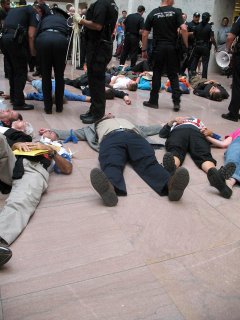
On Tuesday, September 26, more than 100 nonviolent activists took over the central lobby and atrium of the Hart Senate Office Building, and staged a protest of the war in Iraq while dozens and dozens of Senate staffers looked on. For one hour, at least, American opposition to the war in Iraq became the central focus for these offices of the U.S. Senate, and 71 individuals were arrested for making this happen.

The action was organized by the National Campaign for Nonviolent Resistance (formerly the Iraq Pledge of Resistance), as part of the week of anti-war actions around the country organized by the Declaration of Peace campaign.

The action started that morning with a rally and interfaith service at Upper Senate Park. Another remarkable aspect of the day was the presence of national religious leaders, such as Jackie Lynn, head of the Episcopal Peace Fellowship, and Rick Ufford-Chase, Director of the Presbyterian Peace Fellowship and for the past two years the moderator of the 216th Presbyterian General Assembly - the highest office in the denomination. They were not only participating themselves in our nonviolent direct action, but were now urging their faith communities to begin following suit.

At the end of the rally and service we formed a procession to go by the Capitol building and then on to the Senate office buildings. Police stopped us after three blocks, telling us that the large procession constituted an unpermitted demonstration and that we would not be allowed to continue. It was at this point that one affinity group broke away, and crossed police lines and Constitution Ave., carrying a coffin to the steps of the Capitol. Sixteen were arrested for that act of nonviolent witness.

The remaining 200 or so of us, however, were suddenly left without any police presence at all, since literally every one of their officers had followed the coffin. As our goal was to get to the offices of the U.S. Senate, we decided to simply turn around and head back up Constitution Ave. to the Senate office buildings - which we did without incident until some of the police realized their mistake, came roaring back and set up a line to stop us in front of the Russell Senate Office Building, one block short of our ultimate goal.

A small group of us conducted negotiations with an officer of the Capitol Police for 15-20 minutes. Although they continued to assert that our procession was illegal and could not continue - if we wanted to visit our Senators, they said, we had to return to Upper Senate Park (where we did have a permit), leave all our signs and banners behind and break up into small groups - the officer in charge was a model of courtesy, and in fact, an extremely friendly fellow. When their "final" decision was made, our decision was to stay put. We intended to proceed as a group, no matter what, and if they felt compelled to arrest us they would have to do it right there.

The police gave a five minute warning, but that five minutes passed and nothing happened. Ten of our number managed to cross the police line and get to the Russell building entrance, where they were promptly detained and arrested. Others called their senators' offices to demand to know why weren't being allowed in to see them. A giant Gandhi puppet, carrying a sign that said "Be the change you want to see in the world," came rolling down Constitution Ave. and evoked a huge cheer from our crowd, all the more so because the same puppet had earlier been stopped by police who refused to allow it near the Capitol complex. Interestingly, Gandhi was now being given an entire lane of traffic on Constitution Ave.

While all this was happening, Rick Ufford-Chase continued to negotiate with the police. Rick is a pretty darn friendly guy himself, and apparently a heck of a negotiator, since after another 15-20 minutes it was announced that if we left our large banners behind, we would be allowed to proceed as a group, enter the Hart Senate Office Building, and reassemble after passing through security. Rick had re-emphasized our commitment to nonviolence, and had patiently explained that our planned action in the Hart atrium would be a respectful, interfaith-led protest of the war in Iraq. The police explained that if we did that, we would likely be arrested inside the Hart building.

When this agreement was announced, it was immediately apparent how remarkable and unprecedented it was. The Capitol police would allow us to continue what they considered an unpermitted demonstration, and then enter a Senate office building - for the express purpose of carrying out another illegal demonstration. (The charge given those arrested inside was "unlawful assembly.")

While a number of us continued a protest outside, more than 100 of us entered the Hart building. For those not familiar with it, the Hart Senate Office Building is really quite beautiful and unlike any other congressional office building, in that it is designed around a giant, open, building-high lobby and atrium, with senate offices lining the seven stories facing on to the atrium. If you control the atrium, you essentially control the entire building.

And that is precisely what we did. With some reading the names of the dead or holding up peace signs on the balconies surrounding the lobby, a large group assembled in a circle on the first floor for our nonviolent witness against the war. As it went on, the balconies filled with onlookers, until finally all seven stories, on all four sides, were lined with senate staffers and visitors watching the protest and eventual arrests. Several applauded and gave thumbs up. The protest also garnered the front page and a full inside page spread of the following day's Roll Call newspaper, meaning that every office on Capitol Hill knew about it within 24 hours.

I have often heard "this is what democracy looks like" chanted during street marches and protests. Standing in this august senate office building, with our protest being watched by a majority of the people working there, I had the profound feeling that this is exactly what democracy should look like. If our elected leaders refuse to heed the will of the people, then we the people will take over their offices until they do. It happens in other countries around the world, usually to our great approval, so why not here in the U.S. as well? Truly, this was democracy in its purest and finest form.

People were peacefully arrested, and led away. They joined their colleagues from the previous arrests, and had by all accounts a time of great community and fellowship during the several hours it took the police to process and release them all. Those of us waiting outside the police station heard frequent outbursts of laughter and applause. The police officer in charge sought me out at the end to thank me several times over, and stated plainly that they were glad they were able to help us accomplish what we wanted to do that day.

Relationships with police are a complicated and challenging matter for our movement, a source of often heated debate. And this particular police force in question had a somewhat different interpretation of our goal, believing we were there "to be arrested." (While the nonviolent activist is willing to risk arrest and make other sacrifices, our goal is not to be arrested. We usually end up reminding the police of this, and inviting them to not arrest us the next time, but rather to join us.)

The fact remains, though, that this is one of several examples - we've been doing nonviolent actions since before the Iraq war began - where different police forces in the nation's capital not only treated us well, but actually helped us achieve our goal. A large part of that has to do with our own commitment to nonviolence, which leads us to treat all people, including our adversaries and even arresting officers, with openness and respect. Respect them, and often they will respect you in return.

Just as important, though, is the fact that many of these police, possibly even the large majority of them, actually agree with us and support what we're doing. They have privately told our activists this on many, many occasions. They have brothers and sisters and buddies in the military, and lost some of them, and they are just as sick of this war as we are. It reminds one directly of the epilogue in the updated edition of Howard Zinn's classic People's History of the United States, where he argues that a "revolt of the palace guards" may be part of how a peaceful revolution happens in this country. Listening to and working with these police, one gets the feeling the revolution may be a little closer than we think.

Above all, though, we achieved our goal, and for a least one hour on a Tuesday in September, we brought the work of a Senate office building to a standstill, and made loud and clear our demand that the immoral, illegal and unjust occupation of Iraq must end. If we can continue to ramp up our actions in this way, including the extremely important electoral work for this fall, we can and will compel members of Congress to heed our demand.

Gordon Clark is the convener of the National Campaign for Nonviolent Resistance, formerly the Iraq Pledge of Resistance. For news stories and images of these actions, as well as more information, go to www.iraqpledge.org, or www.declarationofpeace.org

Friday, September 08, 2006

Keillor: What Really Makes our Nation Strong

What Really Makes our Nation Strong
by Garrison Keillor
Published on Thursday, September 7, 2006 by the Baltimore Sun (Maryland)

Growing up in the '50s, we imagined our country defended by guided missiles poised in bunkers, jet fighters on the tarmac and pilots in the ready room prepared to scramble, a colonel with a black briefcase sitting in the hall outside the president's bedroom, but Sept. 11 gave us a clearer picture. We have a vast array of hardware, a multitude of colonels, a lot of bureaucratic confusion, and a nation vulnerable to attack.

The Federal Aviation Administration has now acknowledged that the third of the four planes seized by the 19 men with box cutters had already hit the Pentagon before the FAA finally called there to say there was a problem. The FAA lied to the 9/11 commission about this, then took two years to ascertain the facts - a 51-minute gap in defense - and released the finding on the Friday before Labor Day, an excellent burial site for bad news.

So America is not the secure fortress we grew up imagining. Perhaps it never was. What protects us is what has protected us for 230 years: our magnificent isolation. After the disasters of the 20th century, Europe put nationalism aside and adopted civilization, but we have oceans on either side, so if the president turns out to be a shallow, jingoistic fool with a small, rigid agenda and little knowledge of the world, we expect to survive it somehow. Life goes on.

It's hard for Americans to visualize the collapse of our country. It's as unthinkable as one's own demise. Europeans are different: They've seen disaster, even the British. They know it was a near thing back in 1940. My old Danish mother-in-law remembered the occupation clearly 40 years later and was teary-eyed when she talked about it. Francis Scott Key certainly could envision the demise of the United States in 1814 when he watched the bombardment of Fort McHenry. Abraham Lincoln was haunted by the thought. We are not, apparently, though five years ago we saw a shadow.

We really are one people at heart. We all believe that when thousands of people are trapped in the Superdome without food or water, it is the duty of government, the federal government if necessary, to come to their rescue and to restore them to the civil mean and not abandon them to fate. Right there is the basis of liberalism. Conservatives tried to introduce a new idea - it's your fault if you get caught in a storm - and this idea was rejected by nine out of 10 people once they saw the pictures. The issue is whether we care about people who don't get on television.

Last week, I sat and listened to a roomful of parents talk about their battles with public schools in behalf of their children who suffer from dyslexia, or apraxia, or ADD, or some other disability - sagas of ferocious parental love vs. stonewall bureaucracy in the quest for basic, needful things - and how some of them had uprooted their families and moved to Minnesota so their children could attend better schools. You couldn't tell if those parents were Republicans or Democrats. They simply were prepared to move mountains so their kids could have a chance. So are we all.

And that's the mission of politics: to give our kids as good a chance as we had. They say that liberals have run out of new ideas - it's like saying that Christians have run out of new ideas. Maybe the old doctrine of grace is good enough.

I don't get much hope from Democrats these days, a timid and skittish bunch, slow to learn, unable to sing the hymns and express the steady optimism that is at the heart of the heart of the country. I get no hope at all from Republicans, whose policies seem predicated on the Second Coming occurring in the very near future.

If Jesus does not descend through the clouds to take them directly to paradise, and do it now, they are going to have to answer to the rest of us.

Garrison Keillor's "A Prairie Home Companion" can be heard Saturday nights on public radio stations across the country.

Wednesday, August 09, 2006

Smith: A Bowl of Cucumbers and a Pot of Beans

Published on Wednesday, August 9, 2006
by CommonDreams.org
A Bowl of Cucumbers and a Pot of Beans
by Debi Smith

Maybe it was just midnight mind talking. You know, that tendency to get all worried, scared, panicky, stressed about things in the middle of the dark and silent night that wouldn't ordinarily bother you in the light of day? Or at least not as much.

I woke -- around 1:30 -- got up for a glass of water, went back to bed and was unable to get back to sleep for more than an hour. Laid there worrying, of all things, about my writing/blogging. Even considered getting up and deleting all my blogs.

Why?

Several reasons.

Maybe I should be more private. More "off the grid." Less involved with "the vast machine."

Maybe my friends will think I'm strange if they read what I write.

Maybe I suck at writing.

Maybe my opinion is irrelevant.

Maybe it's a waste of my time.

Maybe there are better/more helpful things I could be doing.

Maybe this, maybe that, maybe the other.

I eventually fell asleep. And here I am, the next morning, writing again. I am strangely compelled.

Perhaps it's because of a deep and acute need to push through the shallow and inane in search of deeper awareness and understanding that I am compelled. Yeah, sometimes I worry that I ain't got what it takes. That I'm not capable of diving any deeper than the surface. But no, that's not true. I can dive deep. I can take it all in. And it's not just true for me. We all can. But mostly we don't. Mostly we prefer the shallows. Perhaps it's the sheer scope of all there is to fathom (pun partially intended), that gives us the bends -- some of us even before we descend. For me personally, the problem intensifies back on the surface where I have an even harder time breathing and describing and processing what I've seen.

Once in a while, one particular thing/observation/idea/event will come along and grab my attention and focus and I am compelled to write. And suddenly I feel totally absorbed, connected, fluid, coherent. And the end result feels meaningful and useful.

But lately/usually I feel overwhelmed by everything going on in the world. There is SO much that needs our attention and focus. So damn much. Where to begin? And what have I been writing about? Dreams, soccer, making silly audioblogs, doing the laundry...

Yet, these things are important too, and not necessarily little or meaningless. They are the ordinary in life that we cherish. They are the ordinary that bind us.

I was reading a regretful but important article this morning, After Bomb Kills Loved Ones, Life Turns Ghostly, that tells of the tragic and devastating effect war has had upon one particular Lebanese man. A man who is, among other things, a husband and a father.

I don't know what it means to live in a land where bombs are dropping, and pray I never will -- though if we in America did understand this, maybe we'd be less likely to make the bombs, less likely to be in the business of profiting from them, less likely to export them, less likely to drop them, less likely to support the government that does...maybe.

No, I don't know what it means to live with the very real threat of a bomb landing on my loved ones or me. How can one live normally with such a threat? But I read the article and was touched by the semblance of the ordinary that existed immediately before bombs dropped and destroyed most of this man's family and self.

The rooms were still neatly composed, life suspended. Dishes were done. Laundry — tiny pink pants, a head scarf, a bra — was hanging on lines. But details showed something was wrong. The clothes were dusty from the pulverized concrete and soot of the explosion. A bowl of cucumbers and a pot of beans in the refrigerator were covered with mold.

I just can't imagine it. Can't imagine what it must be like to walk into the rubble and find your five year old daughter torn apart -- her torso and an arm separate from the rest of her body. To find your wife crushed to death. Can't imagine it.

I can't imagine what it's like to do the dishes, hang the laundry, and then run next door hoping to find shelter from a bomb only to be blown to bits.

I can't imagine how the United States is contributing to this carnage. Can't imagine how we have been visiting the same spectre of destruction and carnage and death (oh the shock and awe of it) upon thousands and thousands and thousands of Iraqi civilians for over three years now. And for what? Can't imagine how war is still a thing of the present. Can't imagine why we haven't found a better way.

There are so many other things I can't imagine. Yet they are happening. And they are overwhelming.

Maybe the only way to work through it at the moment, is to take decompression stops along the way. Little writes here and there. Go to the dark places and witness what's there. And once back on the surface -- out of the dark otherworld of fear -- work more diligently at a world I can imagine.

We can all do this, can't we?

Former Apollo astronaut Edgar Mitchell once said:

"[In outer space] you develop an instant global consciousness, a people orientation, an intense dissatisfaction with the state of the world, and a compulsion to do something about it. From out there on the moon, international politics look so petty. You want to grab a politician by the scruff of the neck and drag him a quarter of a million miles out and say, "Look at that, you son of a bitch."

Can we imagine ourselves, like Edgar Mitchell, out in space looking back at our precious planet and all its beautiful people and imagine a world like no other we've ever known? A world of peace, joy, equality, love, health, liberty, justice and unity for all--including the sons of bitches in power? Can we imagine all of us getting together for a bowl of cucumbers and a pot of beans?"

That's what I choose to imagine the next time I have an attack of midnight mind.

Like Buddha said:

"We are what we think. All that we are arises with our thoughts. With our thoughts we make the world."

Debi lives in Ashland, Oregon and is -- among other things -- a mother of two thinking about all the other mothers around the world who are concerned for their children. You may contact her at debi@mind.net or access her blogs through www.babelonpages.blogspot.com